

10 Questions with Alina Khafizova
Alina Khafizova (Алина Хафизова) is an award-winning artist who works in digital and traditional media. She was born in 2005 in Asha, a city in Russia's Chelyabinsk Region. Drawing and animation have been central to her life from an early age, a fascination that has shaped both her technical range and her visual language.
She began drawing as a child, inspired by her brother, a professional painter who first sparked her interest in art and laid the foundation for it. Her father also drew in his younger years, and art has remained a thread through the family.
After graduating from high school in 2023, she began working as a freelance illustrator, creating avatars, digital illustrations, posters, and animated visuals for music videos and creative people and teams. Her work spans traditional and digital media, including gouache, watercolour, pencil, and digital illustration.
In 2026, her work received recognition from international juried platforms such as TERAVARNA, LightSpaceTime, Fusion Art, with pieces awarded and exhibited, including a recent showcase at Golden Duck Gallery in Budapest as part of TERAVARNA's artBIAS IV.
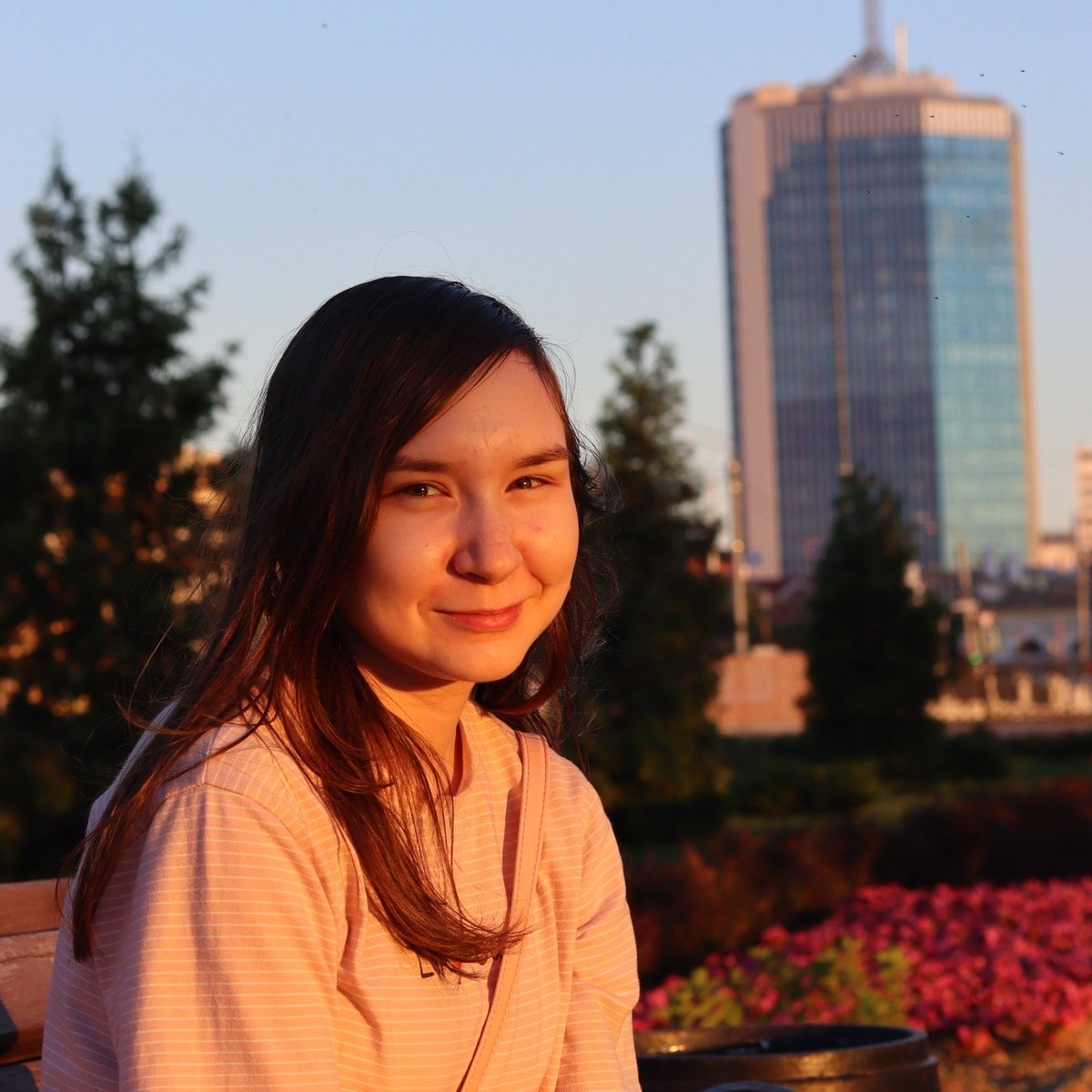
Alina Khafizova - Portrait
ARTIST STATEMENT
“My practice is built around a quiet preoccupation with process, the particular logic of each medium, the decisions it forces, and the discipline it demands.
Gouache suits me for reasons that go beyond technique - it is slow, controllable, and carries the weight of tradition. Watercolour asks for something harder: commitment before certainty, a stroke laid down without the option to take it back. Digital work sits at the other end of that spectrum - fluid, flexible, capable of things that no brush can do.
What unites all three is the moment I work toward: the final pass of small details, the point where a piece either resolves or unravels. Knowing when to stop is, for me, as much a part of the craft as knowing how to start.
My visual references are specific: the hand-drawn animation of Warner Bros., Disney, and Soviet studios, not as nostalgia. A character whose emotion reads in a single line. A composition that holds at a distance. I carry these principles into my digital work, looking for images that feel familiar without being borrowed.” - Alina Khafizova
Masquerade - Love, Digital Illustration, 2026 © Alina Khafizova
INTERVIEW
First off, you started drawing very young. What first made you want to keep pursuing art seriously?
At first, the most important thing was that I simply enjoyed drawing and expressing myself through art. Also, I was encouraged by my brother and by friends, who kept supporting me to continue creating. They motivated me to keep improving and exploring new ideas.
Now my work is reaching not only people close to me, but also a wider audience around the world through exhibitions, art competitions, and social media. The more I create, the more I discover new possibilities within art, and that is what keeps inspiring me.
How did growing up in a family with artistic influence shape your way of seeing and making art?
It taught me to slow down and actually look. I started noticing small details that most people walk past: a particular plant, the way an animal moves, the texture of something ordinary. Growing up around art made me understand that there is something worth seeing in almost everything. That feeling has never left me, and I think it shows in the subjects I keep returning to.
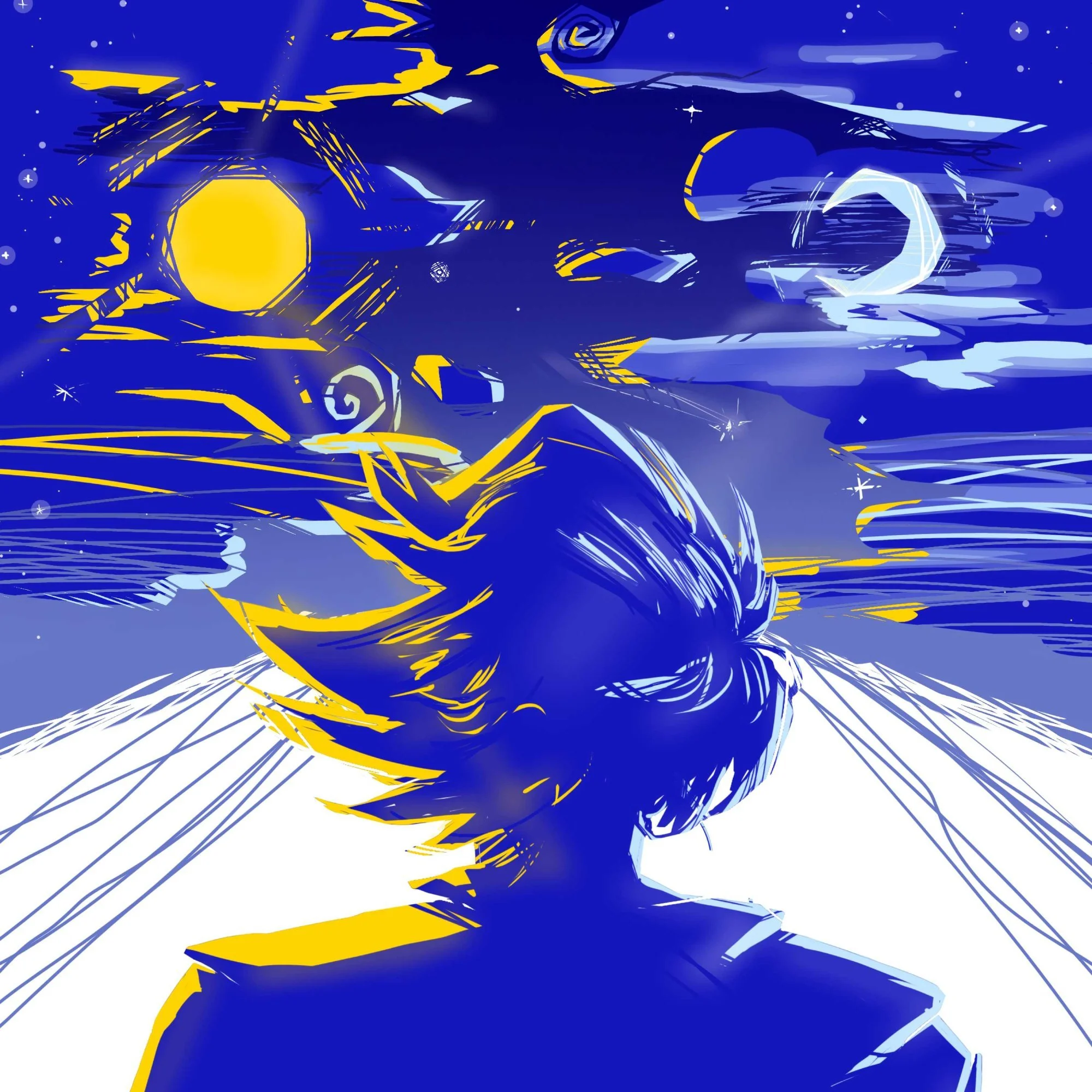
Daytime Moon, Digital Illustration, 2026 © Alina Khafizova
You work across gouache, watercolor, pencil, and digital tools. How do you decide which medium to use for a project?
Honestly, sometimes it is simply whatever is in front of me. But there is also something more intuitive, certain subjects seem to ask for certain materials. I have never painted a stylized portrait in gouache or watercolor, and I have never done a still life digitally. That might change. I am not trying to keep them separate - it is just how things have worked out so far, and I find that interesting.
What does each medium, traditional vs digital, allow you to express that the others don't?
Digital work gives me flexibility I cannot get anywhere else - the ability to blend, layer, undo, and rework without consequence. It allows for a level of detail and smoothness that would be exhausting to achieve by hand, and it opens up possibilities that simply do not exist in traditional media.
Traditional work is different in a way that is harder to describe. Each material has its own character, its own resistance, its own feeling under the hand. You cannot treat gouache the way you treat watercolour, and you cannot treat either of them the way you treat a pencil. That difference is what I find compelling. Right now, gouache is the one I feel closest to among traditional methods.

Mermaid, Digital Illustration, 2025 © Alina Khafizova
Your practice focuses a lot on process. What part of your process do you enjoy the most?
The very end, adding the final small details, stepping back to see an almost completed piece. It is not that I am eager to be done. For me, it's that moment when I can finally look at the work as it was intended to be seen. It is the first time I start enjoying it as a picture rather than a problem.
You mention the importance of knowing when to stop a piece. How do you recognize that moment?
That moment usually arrives if I step away for a time first. If I work with the piece for too long without a break, I stop seeing it clearly - I only see what I have been working on, that specific part, etched in my eyesight. When I come back with fresh, rested eyes, I can tell almost immediately how close it actually is to being finished. The piece either reads well or it does not. That is the only honest way I know to make that judgment.
Your visual references include classic animation studios like Disney and Warner Bros. What draws you to that kind of visual language?
The plasticity of the characters, the way they move, the fluidity of their forms. Everything is clear and expressive without being rigid. And knowing that every single frame was drawn by hand makes it special. You can feel the care of a multitude of artists in it, in every movement, in the backgrounds, in the smallest gestures. That warmth is what I keep coming back to.
When you work on illustrations or animation for clients, how do you balance your own style with external expectations?
I start by showing the client what I do, my actual style, not a version of it adjusted to what I think they want. Then I listen. I ask about tone, about visual direction, about what they are drawn to. Once I understand their preferences, I start with rough sketches, and we find the common ground from there. That process matters; you cannot skip it and expect the result to feel right for either of you.

The Night Owl, Digital Illustration, 2024 © Alina Khafizova
What themes or ideas do you find yourself returning to again and again in your work?
In my traditional work, particularly gouache, I find myself drawn to still life, nature, and animals, quiet subjects that reward close attention. In my digital work, I keep returning to character, stylized figures with a clear personality, a readable emotion, a silhouette that holds. That visual language comes from animation, and it is the thread I find myself pulling on most consistently.
What are you currently hoping to explore or develop further in your practice in the coming years?
What I want to develop further is the connection between the two halves of my practice. In traditional work, that means pushing further into figures and portraits - bringing the same quiet attention I give to a still life or nature to a face, a character, a gesture, a presence in gouache, watercolor, and oil paintings.
In digital work, which includes illustration and animation, that means moving toward something more narrative, not just a character on its own, but a character inside a story, with motion and timing carrying the emotion the way a detail does in a still image.
Ultimately, what drives me is the need to express, and I follow that across whatever medium fits the idea.
Artist’s Talk
Al-Tiba9 Interviews is a promotional platform for artists to articulate their vision and engage them with our diverse readership through a published art dialogue. The artists are interviewed by Mr. Mohamed Benhadj, the founder & curator of Al-Tiba9 Contemporary, to highlight their artistic careers and introduce them to the international contemporary art scene across our vast network of museums, galleries, art professionals, art dealers, collectors, and art lovers across the globe.


Peilin Li is an illustrator and designer at BUCK, based in Los Angeles. She works across illustration, branding, and motion. Inspired by picture books, comics, and everyday life, she creates lively, character-driven scenes that capture the humor, chaos, and warmth of ordinary moments.