
10 Questions with Long Phi Tran
Long Phi Tran (b. 1989) is a Vietnamese ink painter based in Ho Chi Minh City. Working with traditional East Asian ink on paper, he develops a restrained monochrome language that examines scale, solitude, and the fragile position of the individual within systems of power. His practice merges material discipline with conceptual inquiry, allowing emptiness and contrast to function as psychological and structural tension.
Tran’s work has received international recognition. In 2026, his artwork was selected as the cover of Heart Rhythm Journal (Vol. 23, Issue 1), published by Elsevier. He was also featured in Visual Art Journal (Issue #47, February 2026) and presented in the Journal’s Times Square Showcase in New York.
In Vietnam, his work has appeared in university-level final examinations (2025) and has been featured by the Vietnam UNESCO Federation Magazine and Voice of Vietnam (VOV).
Alongside his ink practice, Tran works as a conceptual photographer; in 2025, he received an Honourable Mention at the Monochrome Photography Awards.
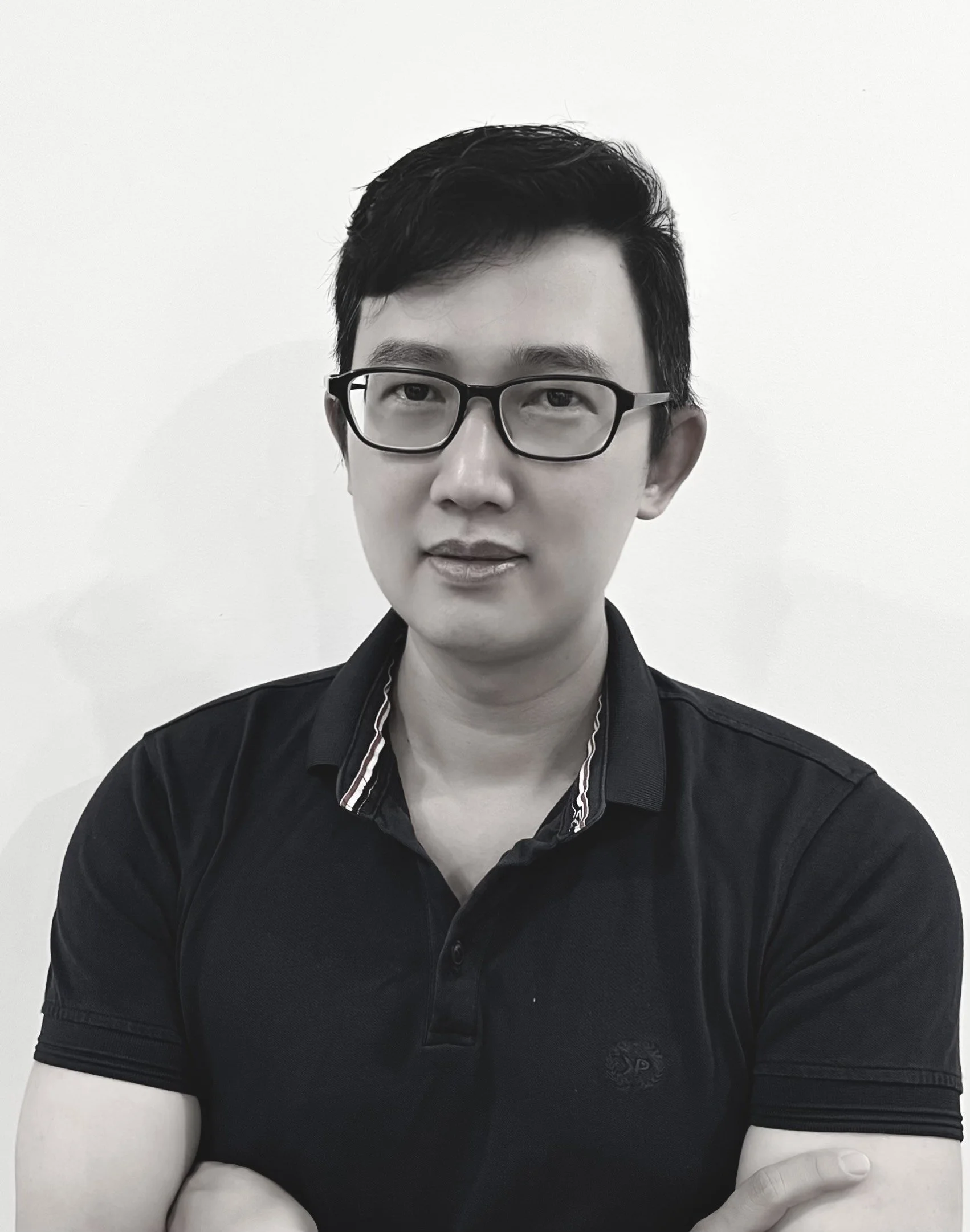
Long Phi Tran - Portrait
ARTIST STATEMENT
Working with traditional East Asian ink on paper, Tran constructs surreal visual narratives that examine the fragile position of the individual within political and social structures. Ink, with its discipline and restraint, carries centuries of cultural memory; he employs this inherited language to question contemporary systems of power and conformity. His compositions are deliberately minimal, allowing emptiness to function as silence, distance, or invisible pressure. Through subtle contrasts of black and white, he stages restrained confrontations between human presence and imposed order. Figures often appear diminished, isolated, or partially obscured, suggesting vulnerability rather than spectacle. By merging classical material with conceptual inquiry, Tran reveals how authority can feel both intangible and overwhelming. Rather than direct protest, the work invites quiet reflection. Within stillness and space, it considers solitude, scale, and the enduring tension between individual agency and the vast structures that shape human existence.
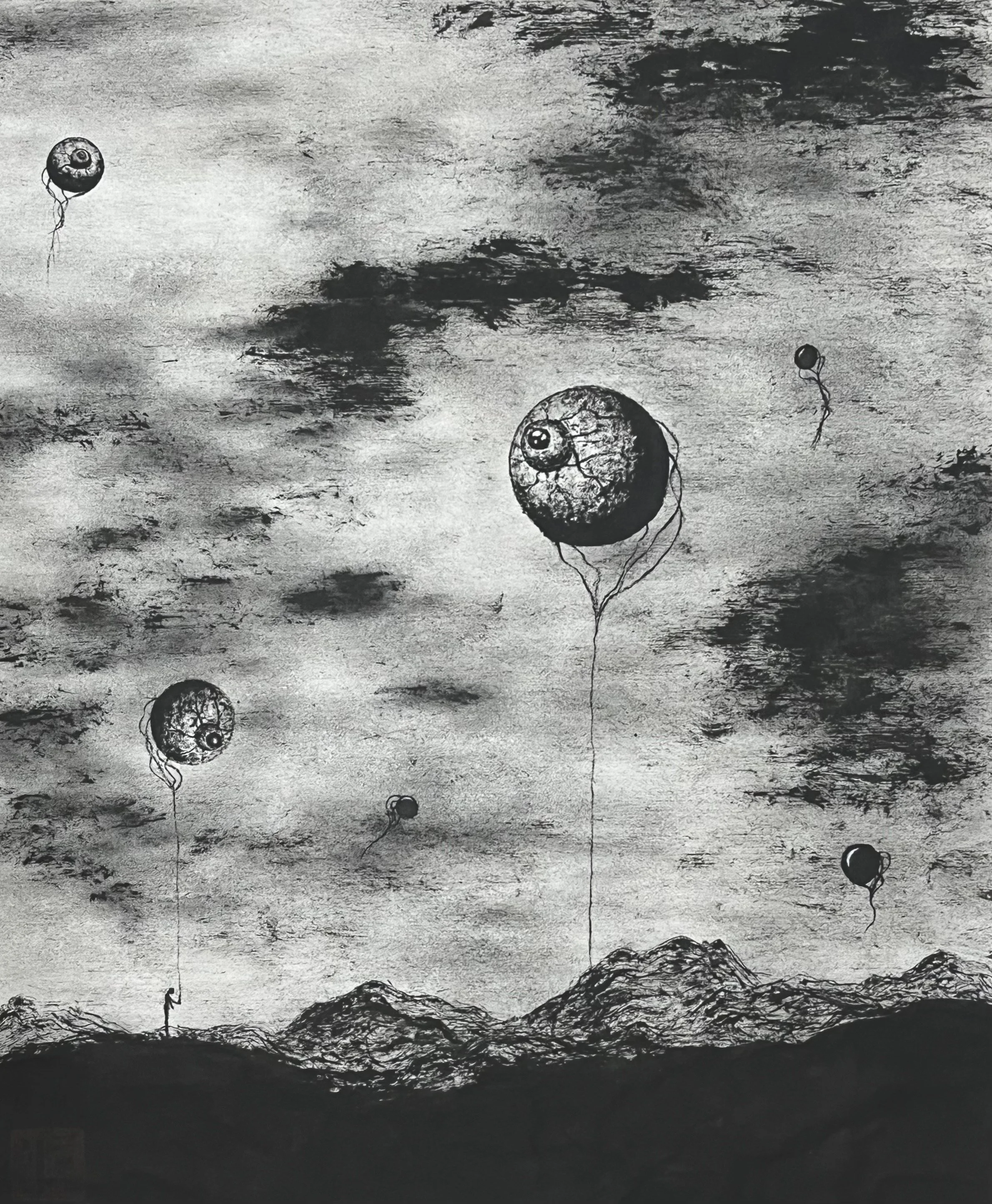
A Definition of Freedom of Visions, ink on paper, 35x60 cm, 2026 © Long Phi Tran
INTERVIEW
You work with traditional East Asian ink. What first drew you to this medium?
What drew me to traditional East Asian ink, specifically within the context of Vietnamese heritage, is its profound simplicity and soul. I have always felt that these time-honoured materials, like Xuan paper and natural pigments, possess a quiet resilience that modern mediums often lack. My goal isn't just to preserve the past, but to use these traditional Vietnamese materials to tell contemporary stories. I believe that by filtering modern life through the lens of ancient ink techniques, I can give my work a unique 'colour', one that feels both nostalgic and relevant. It’s about finding a balance: using the delicate, fluid nature of the ink to capture the complexities of today’s world. This approach allows me to stay grounded in my roots while creating a visual language that is distinctly my own, without being overly decorative or pretentious.
How does living and working in Ho Chi Minh City influence your practice?
Living and working in Ho Chi Minh City, the most modern and fast-paced metropolis in Vietnam, profoundly shapes my artistic perspective. The city is a place of stark contrasts: while the skyline grows taller and the streets more crowded, there is an underlying sense of urban loneliness that permeates daily life. The relentless hustle and the constant struggle for a livelihood often leave individuals feeling isolated amidst the noise. I find myself observing this paradox, how people can be so physically close yet emotionally distant. In my practice, I use traditional ink to capture these modern anxieties. The fluid, sometimes unpredictable nature of the medium allows me to depict the "blur" of city life and the quiet, solitary moments of its inhabitants. By contrasting ancient techniques with the cold reality of urban isolation, I hope to give a voice to those silent stories, making the "urban loneliness" visible and deeply personal.

The Pilgrim and The Total Dominion of Time, ink on paper, 35x60 cm, 2024 © Long Phi Tran
Your work often explores solitude and vulnerability. Where does this interest come from?
My interest in solitude and vulnerability isn't derived from abstract concepts, but from observing the lived reality. I’ve realised that loneliness isn't necessarily a negative state; it is a natural condition that emerges when we try to maintain our sense of self against the pressures of modern life. I am drawn to those quiet moments when we shed our 'social masks' to face our inner selves, moments where we are at our most fragile, yet most authentic. Traditional ink and Xuan paper allow me to portray this shift naturally. The fluid diffusion of ink mimics the way unnamed emotions spread through the mind, while the delicate surface of the paper represents the human soul's vulnerability. Through my work, I want to create a silent space for the viewer, a place where their own solitude feels understood and soothed, rather than something they need to escape from.
Emptiness plays a strong role in your compositions. What does “empty space” mean to you?
In my compositions, emptiness is never truly "blank"; it is a vital, breathing element. This approach is rooted in the traditional philosophy of East Asian ink wash painting, known as Liu Bai (leaving white space), and I intentionally preserve this spirit in my contemporary practice. To me, empty space is not a lack of content, but a vessel for emotion and a pause for reflection. In the context of modern life, where every second is crowded with noise and information, these open areas on Xuan paper represent the silence we often crave. They act as a visual counterpart to the "urban loneliness" I explore, providing a sanctuary where the subject and the viewer can exist without distraction. By maintaining this traditional technique, I allow the ink to resonate more deeply. The emptiness invites the audience to step into the painting, completing the story with their own experiences, making the invisible as powerful as the visible.
Your figures often appear small within larger structures. What are you trying to express through scale?
In my work, the deliberate use of scale, placing small, solitary figures within vast, looming structures, is a visual metaphor for the relationship between the individual and the modern world. I want to express the feeling of being overwhelmed, yet strangely liberated, by the sheer magnitude of our surroundings. Drawing from the traditional landscape philosophy where humans are but a small part of the vast natural cosmos, I translate this into an urban context. These large structures represent the weight of societal expectations and the passage of time. By making the figures small, I highlight their vulnerability and the quiet persistence it takes to exist within such an expansive void. It’s not about insignificance; it’s about the bravery of a single ink stroke standing its ground against the emptiness. I want the viewer to feel that tiny spark of humanity that remains visible, even when the world feels immeasurably large and indifferent.

A Definition of Art Criticism, ink on paper, 35x60 cm, 2025 © Long Phi Tran

Human Circles, ink on paper, 35x60 cm, 2025 © Long Phi Tran
Ink carries a long cultural history. How do you balance tradition with contemporary concerns in your work?
Balancing the weight of cultural history with contemporary life is a delicate dialogue, not a conflict. For me, tradition is the language, while the modern world is the subject matter. I don’t view ink and Xuan paper as relics of the past, but as living tools capable of articulating the complexities of today. I maintain the technical rigour of traditional ink wash, such as the mastery of brushwork and the philosophy of "leaving white space", but I shift the gaze. Instead of ancient landscapes or scholarly symbols, I focus on the silent tensions of the modern individual: the isolation within a crowd, the cold geometry of urban architecture, and the raw vulnerability of the human spirit. By stripping away the decorative elements often associated with "classic" art, I allow the medium’s inherent simplicity to meet the stark reality of the present. This balance ensures my work remains rooted in my heritage while speaking a universal, contemporary truth that resonates beyond borders.
Rather than direct protest, your work invites quiet reflection. Why is subtlety important in your approach?
Subtlety is the quiet strength of traditional ink. In a world that is often loud and demanding, I find that direct protest can sometimes close doors, whereas subtlety invites the viewer to walk through them. To me, the "whisper" of a grey wash or a delicate line is more resonant than a shout. This approach allows the audience to find their own reflection within the work. If I provide all the answers through overt symbols, the conversation ends. But by using the nuanced gradients of ink and the vastness of empty space, I create a meditative tension. It mirrors the way we often process our own vulnerability, not through grand gestures, but through quiet, internal realisation. Subtlety respects the viewer’s intelligence and emotional autonomy. It turns the act of looking into an act of listening. By leaning into the gentle, flowing nature of my medium, I hope to offer a sense of solace that lingers long after the initial encounter, making the "unspoken" the most powerful part of the piece.
In 2026, your work was selected as the cover of Heart Rhythm Journal. How did that recognition impact you?
Having my work featured on the cover of Heart Rhythm Journal in 2026 was a profound milestone for my practice. Being recognised by such a prestigious Elsevier publication felt like a beautiful validation of the bridge I am trying to build between traditional art and modern existence. It gave me the confidence to continue using my "distinct colour" to tell stories that are both deeply personal and globally relevant. This moment wasn't just about visibility; it was about the power of a whisper being heard in a world of complex data.

Black and White and The Collapse of A Concept, ink on paper, 35x60 cm, 2025 © Long Phi Tran
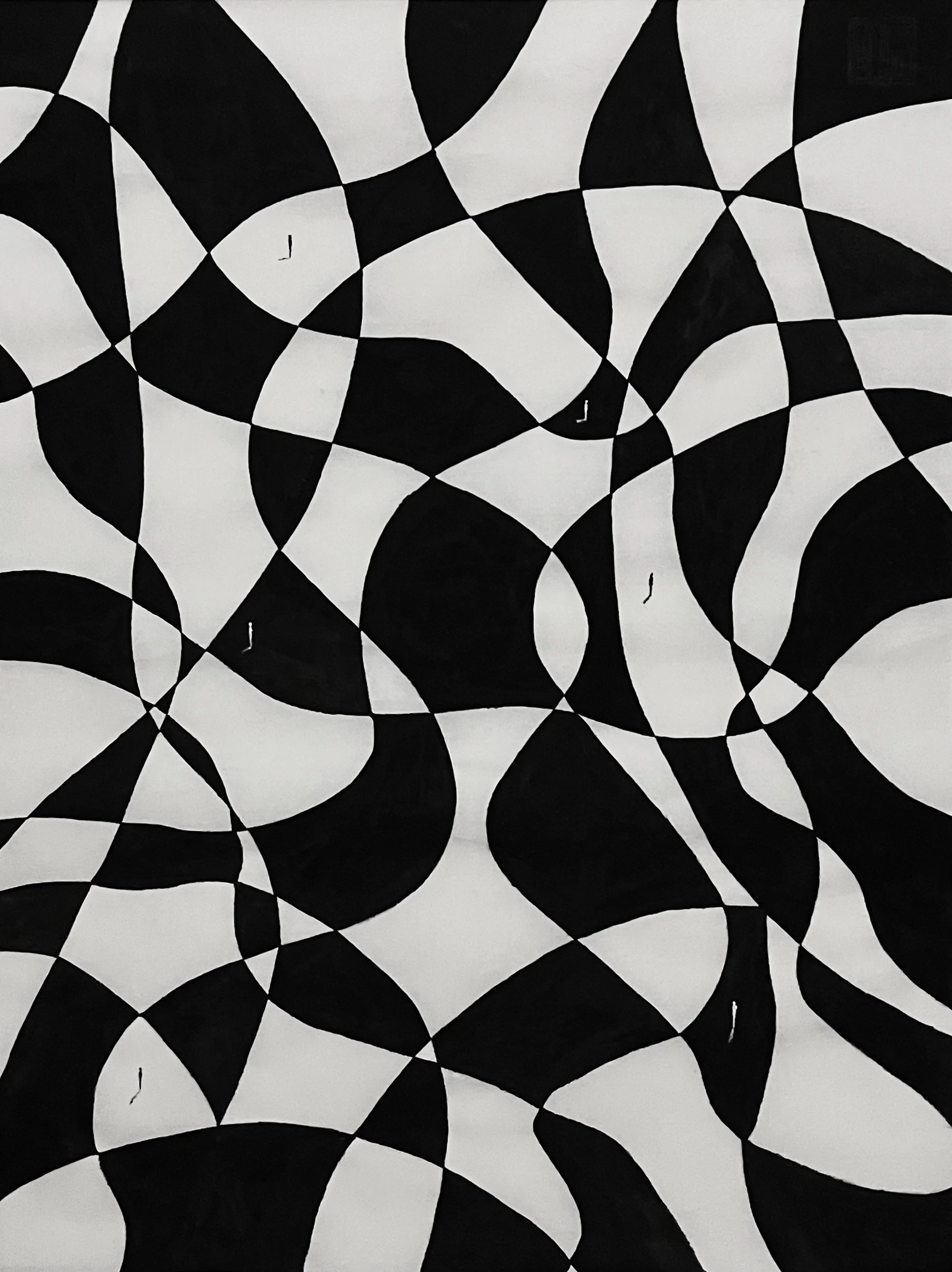
Individual Solitudes, ink on paper, 35x60 cm, 2026 © Long Phi Tran
You also work as a conceptual photographer and received recognition from the Monochrome Photography Awards. How does photography influence your ink practice?
Photography and ink painting may seem like opposites, but in my practice, they are two sides of the same lens. Receiving recognition from the Monochrome Photography Awards was a pivotal moment because it validated my obsession with light, shadow, and the "grey scale", elements that are the very lifeblood of traditional ink. Conceptual photography taught me how to "frame" a story before the brush even touches the Xuan paper. It sharpened my eye for compositional silence and the power of a single focal point. When I photograph, I am looking for the same loneliness and vulnerability that I paint. The camera captures the raw, fleeting moment of reality, while the ink allows me to filter that reality through a meditative process. This cross-disciplinary approach allows my ink practice to feel more structural and cinematic. Photography provides the modern perspective, the "what" of the city, while ink provides the timeless soul, the "how" of the feeling. Together, they create a dialogue where the precision of the lens meets the fluid, breathing life of the brush.
Lastly, what questions are you currently asking yourself as an artist? And how do you see your work evolving next?
The primary question I find myself asking is: "How can a traditional whisper remain audible in an increasingly loud world?" I am constantly exploring whether the simplicity of ink and Xuan paper can continue to serve as a sanctuary for modern anxieties without losing its historical soul. I wonder how far I can push the boundaries of "emptiness" before it becomes silence, and how much of our collective vulnerability can be captured in a single, unrepeatable stroke. Looking forward, I see my work evolving toward a more interdisciplinary dialogue. I want to further bridge the gap between the precision of the lens and the fluidity of the brush. I envision my future compositions becoming even more structural, perhaps incorporating larger-scale installations where the viewer doesn't just look at the loneliness but physically walks through it. My goal is to refine my "distinct colour" until the tradition I carry becomes a seamless, living part of the global contemporary narrative.
Artist’s Talk
Al-Tiba9 Interviews is a promotional platform for artists to articulate their vision and engage them with our diverse readership through a published art dialogue. The artists are interviewed by Mohamed Benhadj, the founder & curator of Al-Tiba9, to highlight their artistic careers and introduce them to the international contemporary art scene across our vast network of museums, galleries, art professionals, art dealers, collectors, and art lovers across the globe.

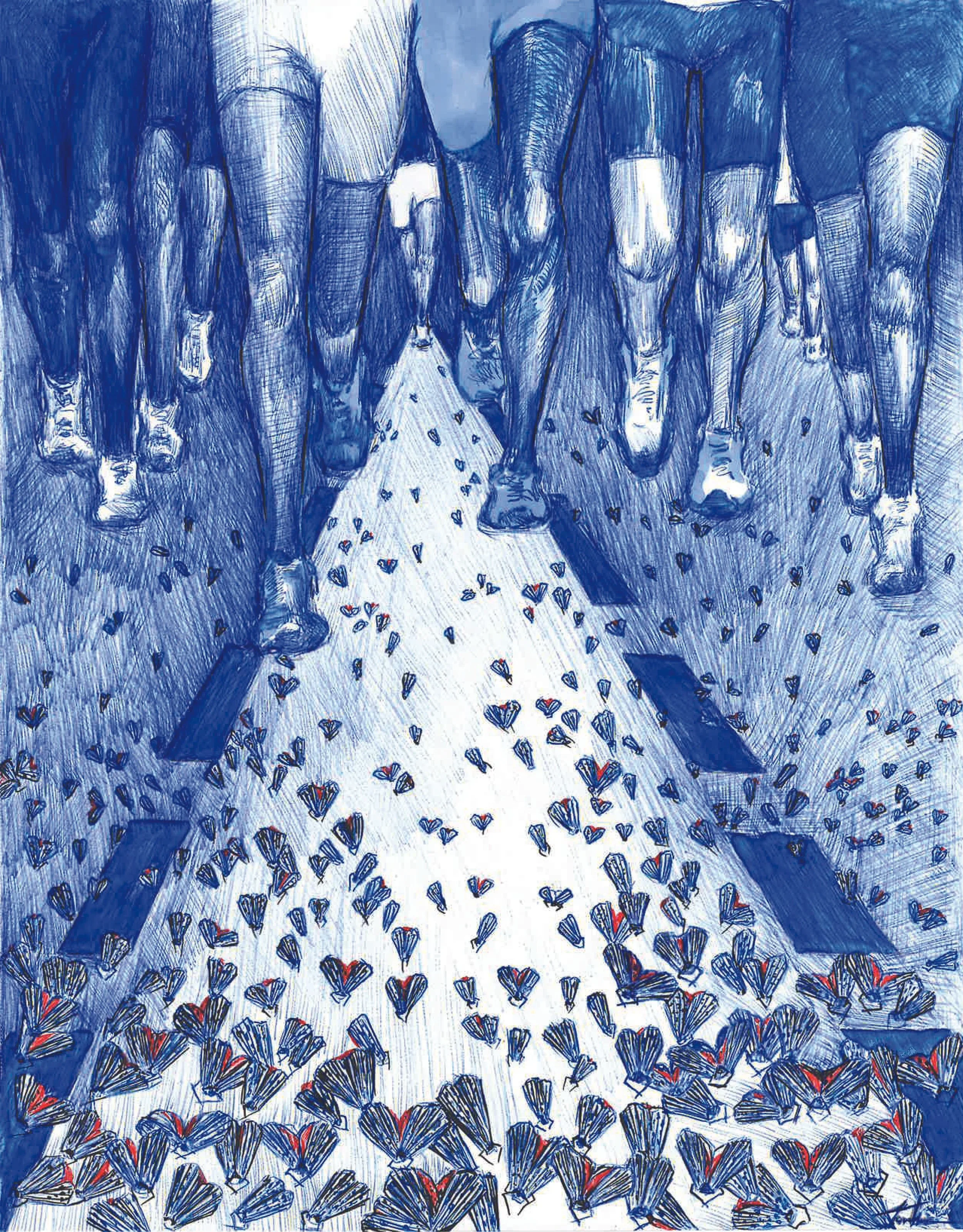


Carla D'Amato's work grew from a close observation of life’s contrasts and the human condition. With an architectural foundation and European training that expanded her technical range, she refined a disciplined craft while continuously pushing the boundaries of image, material, and meaning. Through an intense, ongoing exploration, Carla developed her own authored technique: Performance Painting.