
10 Questions with Anastasiya Kao
Anastasiya Kao is a contemporary artist working in a unique technique that combines crystal, mirror, glass, and resin.
Through her works, she explores themes of human boundaries, inner strength, and transformation, turning light and reflection into metaphors of consciousness and rebirth. Each of Anastasiya’s creations is a dialogue between fragility and resilience, destruction and regeneration, darkness and light.
Her works have been distinguished in international competitions and recognised by the artistic community, such as the Golden Time Talent, London, United Kingdom (2024) (1st and 2nd Prize among 285 participants), and the Mustach Dali, Spain (2025) (2nd Prize among 364 participants).
Anastasiya’s works are held in private collections in France, Switzerland, the United Kingdom, Portugal, and Spain, and attract attention from critics and institutions for their artistic strength, philosophical depth, and social resonance.
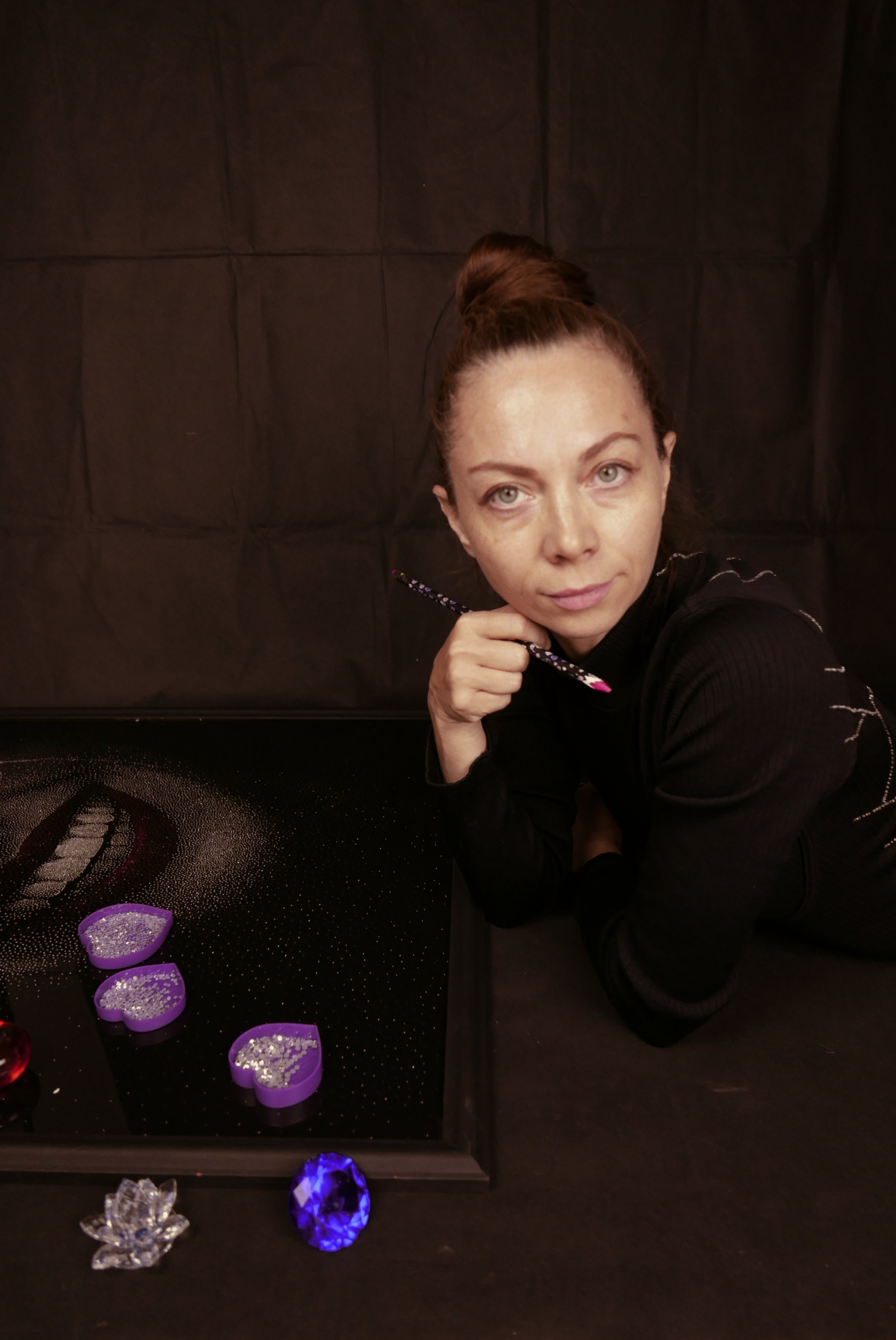
Anastasiya Kao - Portrait
ARTIST STATEMENT
Anastasiya is the author of the international art project “Transparent Borders / Frontières Transparentes”, dedicated to themes of violence, healing, and inner freedom. The project has been presented in London (Boomer Gallery), Zurich (SwissArtExpo), and Germany.
Alongside her gallery activity, Anastasiya develops artistic and social initiatives in public space, including the urban project in France, “My City — A Reflection of Who I Am”, which creates mirror installations connecting art, architecture, and the personal identity of residents.
“Through reflection and light, I speak about the fragility that makes us alive. Art is not an ornament, but an act of healing and strength.”
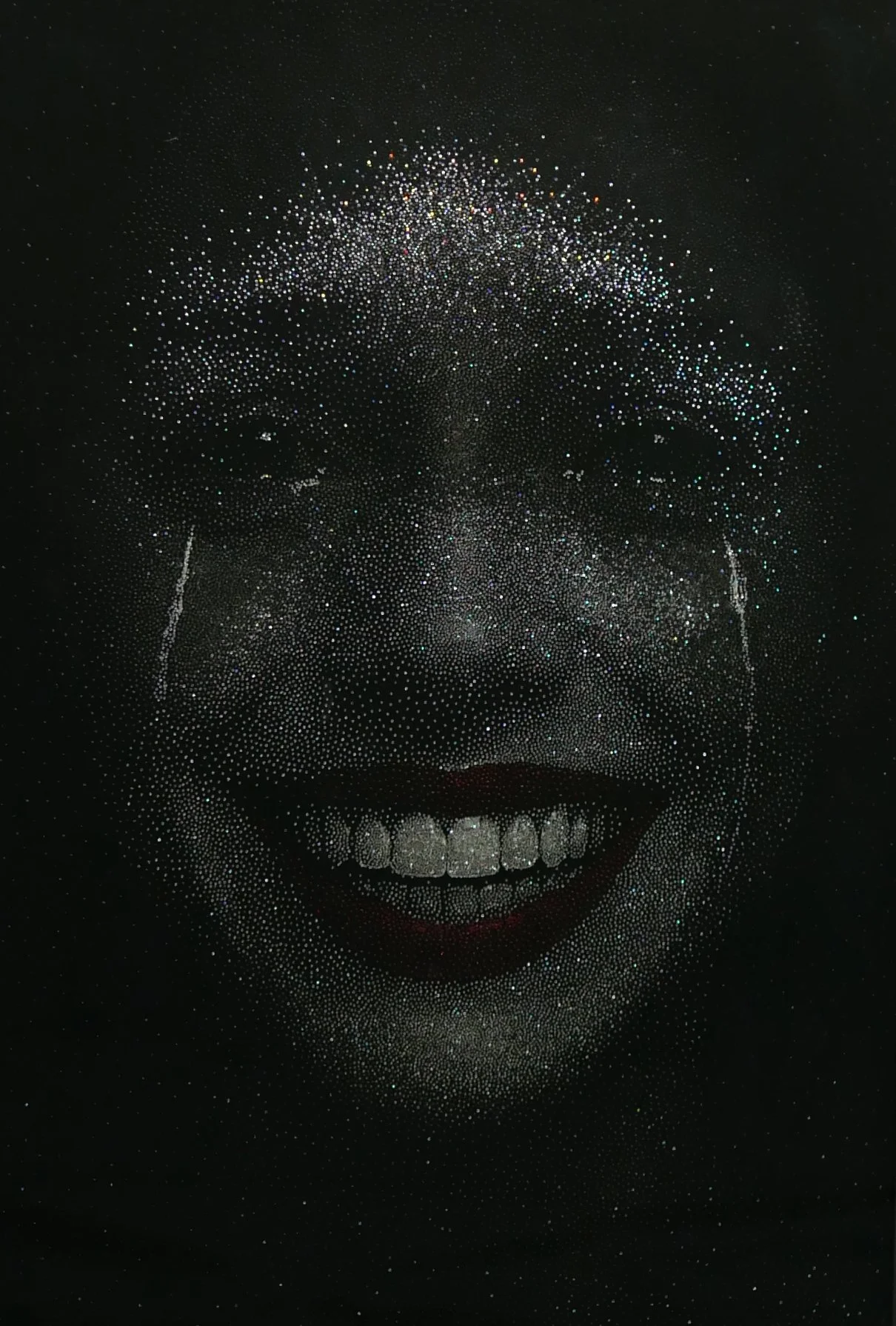
I Am Here, But I Am Not, Glass, acrylic, 38,875 crystals, 70 × 100 cm, 2025 © Anastasiya Kao
INTERVIEW
First of all, please introduce yourself to our readers. Who are you, and when did your interest in art first begin?
My name is Anastasiya Kao. I am a conceptual artist working with glass, mirrors, crystals, and light as my primary media. In my practice, I explore themes of human boundaries, fragility and resilience, as well as processes of inner transformation that are rarely visible externally.
My interest in art began in childhood. I drew extensively and was intuitively drawn to photorealism. At school, teachers often did not believe that the works were done independently. My parents supported my interest and enrolled me in art school.
However, my artistic orientation did not align with the academic system of training. I was striving for precision and detailed realism, while I was expected to develop a different visual language. At a certain point, I felt an internal dissonance and stepped away from art for many years.
I returned to it much later, already in adulthood, during a period of isolation and motherhood. Creativity was not an ambition or career strategy, but a way to preserve inner integrity. That was when I began working with glass and crystals, experimenting with reflection, transparency, and light.
My childhood attraction to precision largely shaped my current attention to detail and structural discipline. Only now, instead of a pencil, I use glass, mirrors, and thousands of crystals. Over time, this personal exploration evolved into a conscious artistic practice in which the study of material, structure, and meaning became the foundation of my language.
Did you receive formal artistic training, or did you develop your technique independently?
My development has been largely independent. Although I studied at art school in my childhood, my current practice was formed later in adulthood through experimentation and material research. Glass, crystal, and mirrored surfaces require not only artistic vision but also a precise understanding of construction, weight, load distribution, fixation, and interaction with light.
I built my technique gradually through experimentation and testing different solutions. It is important for me to understand how material behaves physically, how it responds to scale, space, and lighting. This path allowed me to develop my own visual language, one that does not rely on academic templates but is built around concept and structure.
In my practice, technique is not decorative, it carries meaning. The method of attachment, the density of placement, the choice of stone or glass, all of it serves the idea.
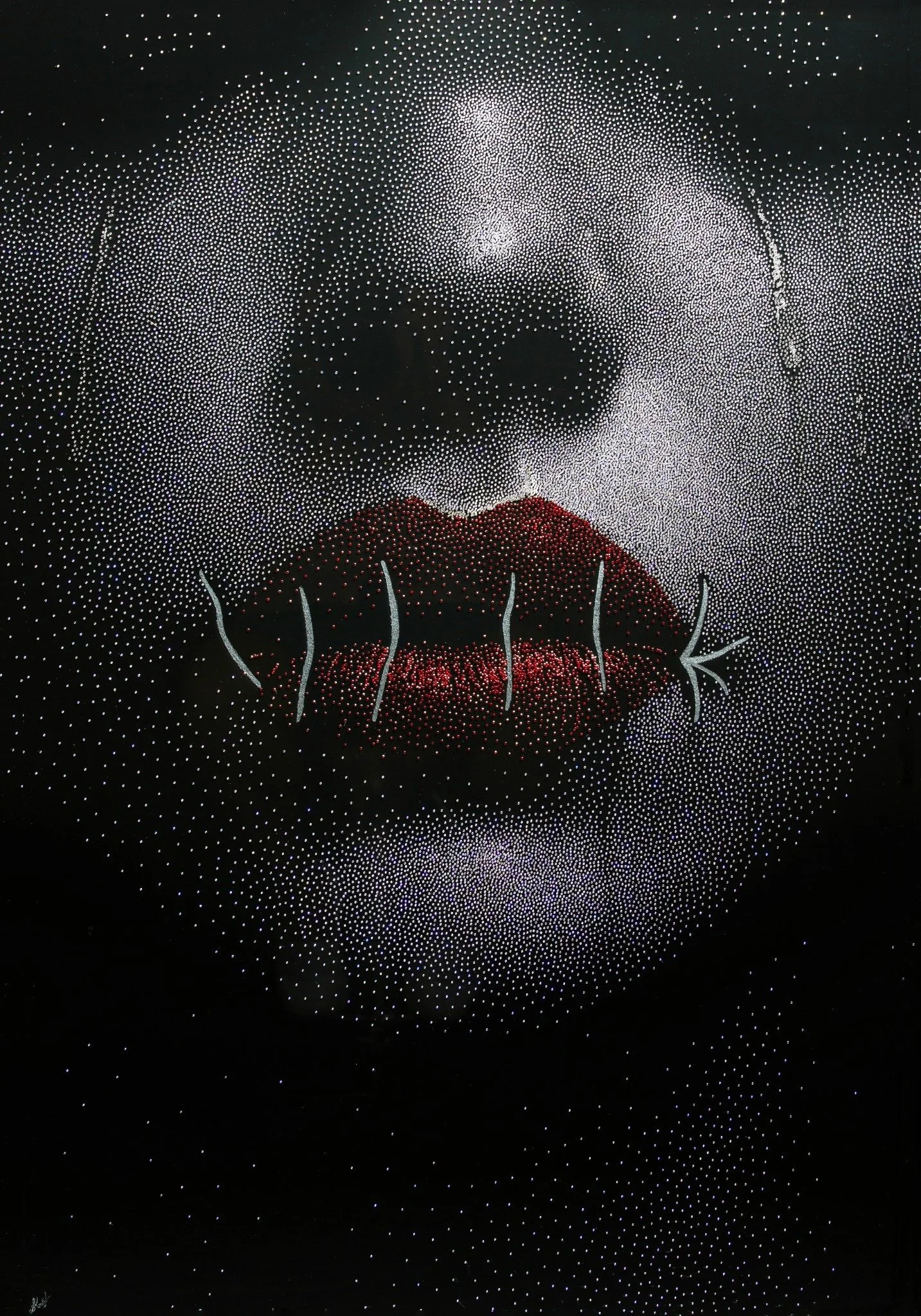
Silence of the Victim, Glass, acrylic, engraving, 29,640 crystals, 70 × 100 cm, 2025 © Anastasiya Kao
You work with glass, mirror mosaic, crystal, resin, and acrylic. What attracted you to these reflective and fragile materials?
I was drawn to the internal contradiction of these materials, and to the fact that they serve as precise metaphors for human nature.
Glass appears solid and stable, yet remains fragile. It can easily be broken, and once broken, it cannot be restored to its original state. A mirror reflects reality, but the reflection always depends on the angle of view. on the position of the observer. For me, crystal represents how experience, trials, and “cutting” shape and reveal inner light. In order to shine, the material must undergo transformation. Resin fixes form, yet itself passes through a stage of fluidity and transformation before becoming stable.
At a certain moment, I realised that such materials allow me to speak about boundaries more precisely than traditional painting. Transparency becomes an almost perfect metaphor: a boundary exists, it is visible, yet it can easily be ignored until it is crossed.
Beyond the philosophical dimension, I am also attracted by the physical complexity of working with these materials. Glass demands calculation, weight, load, fixation, and pressure distribution must all be carefully considered. In this combination of fragility and structural discipline, I found a language that aligns with my themes.
I continue to experiment, observing how material behaves at different scales, under different weights and tensions. For me, it is not only about aesthetic effect, but about how the material functions in space, how it reacts to light, movement, and environment. It is within this intersection of risk, light, reflection, and engineering discipline that I found my artistic voice
Light and reflection play a central role in your practice. What do they symbolise for you?
Light, in my practice, is an activator. Without light, a crystal remains simply a material. When a beam falls on it, each element begins to work, reflecting, refracting, and intensifying. At that moment, the complete image emerges. The artwork comes alive not through pigment, but through light energy.
For me, light represents the manifestation of inner potential. A crystal may seem neutral until it encounters illumination, then it begins to shine. I see this as a metaphor for human nature: inner light is always present, but it reveals itself only under certain conditions.
Mirrors in my works serve a different function. They do not simply include the viewer in the composition, they create duality. We see ourselves inside the artwork, yet we understand that our reflection depends on angle, light, and position. To me, this reflects the idea that a person is both shaped by the world, its norms, expectations, and structures, and simultaneously perceives the world through their own internal experience. We shape our environment, and we are shaped by it. We look at the world, yet inevitably see ourselves within it. This duality is not a conflict, but a condition. Light reveals form; the mirror returns the image.
In that intersection, the artwork becomes not an object, but a space of awareness.
Your works often explore human boundaries, inner strength, and transformation. Why are these themes important to you?
These themes are important to me because boundaries are the foundation of human resilience. I chose glass specifically for its transparency. A boundary may be invisible, yet firm and real. At first glance, it may not be noticeable, which makes it easy to ignore, dismiss, or violate. Glass allows me to demonstrate this paradox literally. It may seem absent, yet it exists. And once broken, it cannot return to its original wholeness. Through material, I make visible the importance of personal boundaries, not as an abstract psychological term, but as a physical reality with consequences. Inner strength, in my works, is the ability to preserve structure, to recognise and maintain one's limits. Transformation is the process of restoring resilience after pressure.
© Anastasiya Kao
There is a strong dialogue between fragility and resilience in your works. How do you embody this tension materially?
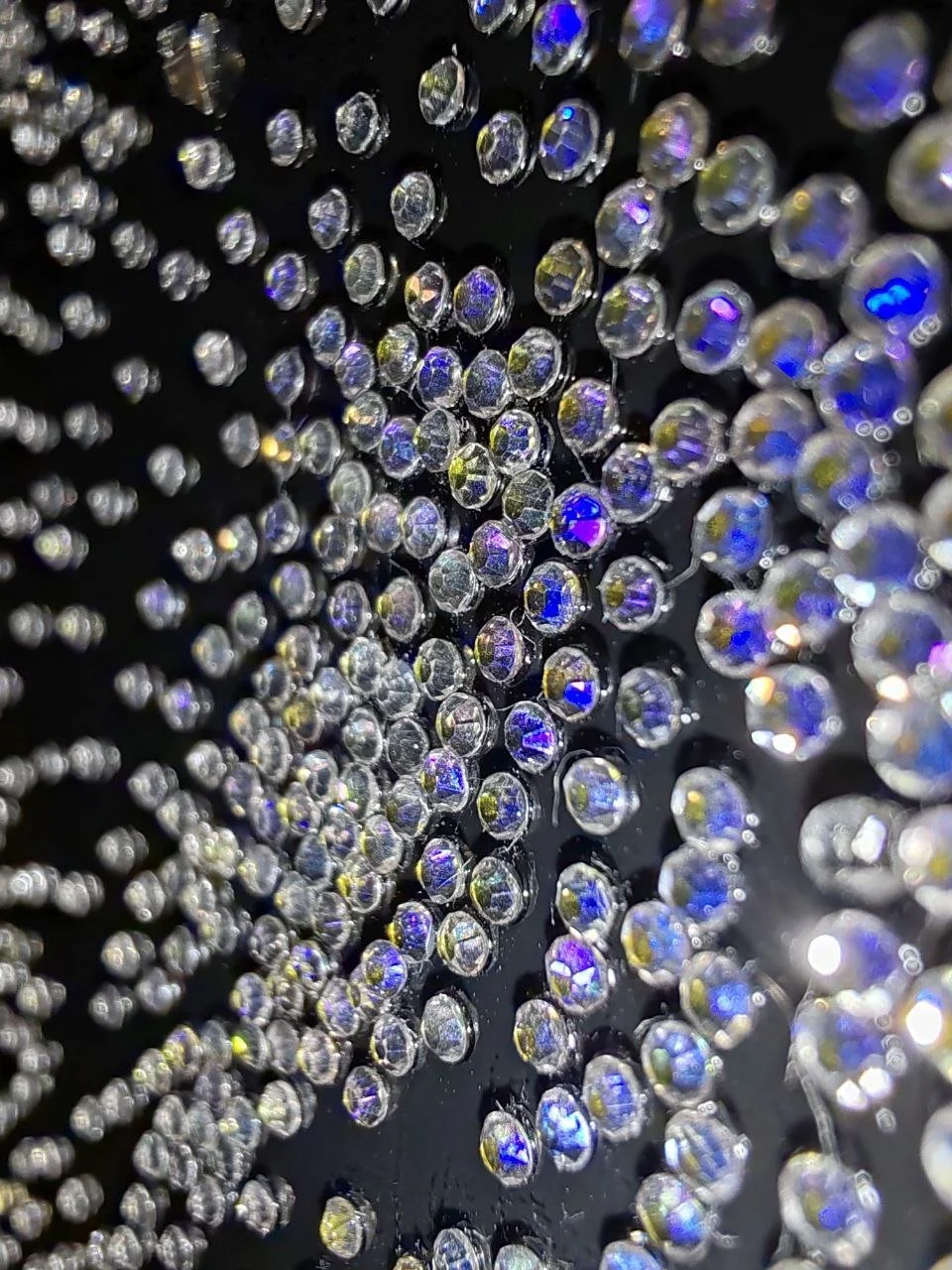
For me, this is primarily a visual contradiction. I combine materials of different natures. Glass is transparent and fragile. Crystal is cut, solid, and durable. In this combination, tension arises: a nearly invisible base and precise elements that possess their own strength. Fragility exists within the material itself, while resilience appears through structure and precision. My works are not flat paintings. They are physical surfaces that respond to light. When illuminated, the crystals create volume and begin to project forward, forming spatial movement. The artwork literally extends beyond the plane. This effect is particularly visible in “Silence of the Victim” and “I Am Here but I Am Not,” where light intensifies the relief and creates a sense of internal tension, as if the image gradually emerges from within. Currently, I am intensifying this contrast by introducing jewellery-grade zirconia, a significantly stronger material. The opposition between transparent glass and solid cut stone further emphasises the dialogue between vulnerability and resilience. The tension arises not from destruction, but from contrast: transparency and density, lightness and hardness, surface and volume.
How did audiences respond to the Transparent Borders project?
I am always very attentive to audience reactions; they are the most honest indicator of whether I was able to express what I intended. At exhibitions, I observed people walking past and then suddenly stopping. Sometimes they stood in front of the work for 30 or 40 minutes, simply looking, in silence. In those moments, the work ceases to be an object and becomes an inner dialogue. There were also emotional reactions. On several occasions, women stood beside the works in tears. For me, this is not about drama, but recognition, when someone sees something personal within the piece. One visitor said, “I really need to leave, but I can’t walk away. It’s mesmerising.” For me, such words are the highest evaluation. Genuine emotion is always more valuable than formal approval. After the exhibition at Boomer Gallery, the project received additional professional attention, including an invitation to create a profile on the Artsy platform. This became an important step in its international development.
You have received awards from competitions such as Golden Time Talent and Mustach Dali. How has this recognition influenced your career?
At the beginning of my path, external professional evaluation became confirmation that my visual language resonates beyond my personal space. These awards marked a transition toward more structured and professional development, forming coherent series, refining presentation, and building an international presence. Recognition did not create a sense of completion. Rather, it added responsibility. If the work resonates, it must continue to evolve, deeper and on a larger scale.

Illusion of the Gaze, Triplex glass, acrylic, mirror, resin, 25,538 crystals, 65 × 85 cm, 2026 © Anastasiya Kao
Your works are in private collections across several European locations. What feedback do you most often receive?
Today, my works are held in private collections in Geneva, London, Madeira, and France. Collectors often note that the artwork fully reveals itself in real space. Photography cannot convey the depth, volume, and interaction with light. In person, the piece changes throughout the day, depending on lighting and the viewer’s position, creating a sense of living presence. Many works are created through individual commissions, which involve a deeper dialogue and integration into a personal space. Collectors and viewers often mention the duration of engagement, as they return to the work repeatedly. For me, this is especially meaningful. Art should not function instantly, but over time.
What are you currently working on, and how do you see the future development of your work?
I continue working on the “Transparent Borders” series, moving into its final phase, transformation, acceptance, and the formation of inner core strength. While the earlier works focused on vulnerability and tension, I am now interested in resilience and structural clarity. At the same time, I am strengthening the material language by introducing jewellery-grade zirconia. It enhances contrast and elevates the works to a new level of precision and status. It is no longer only about light, but about the intersection of artistic and jewellery craftsmanship. In the future, I see my practice developing on a larger scale and within institutional contexts. It is important for me that the theme of “Transparent Borders” be presented on international platforms where questions of human dignity and personal responsibility are particularly relevant. Discussions are currently underway regarding a possible realisation of the project within the United Nations space. The next stage for me is the expansion of scale while preserving structural precision and conceptual depth.
Artist’s Talk
Al-Tiba9 Interviews is a promotional platform for artists to articulate their vision and engage them with our diverse readership through a published art dialogue. The artists are interviewed by Mohamed Benhadj, the founder & curator of Al-Tiba9, to highlight their artistic careers and introduce them to the international contemporary art scene across our vast network of museums, galleries, art professionals, art dealers, collectors, and art lovers across the globe.





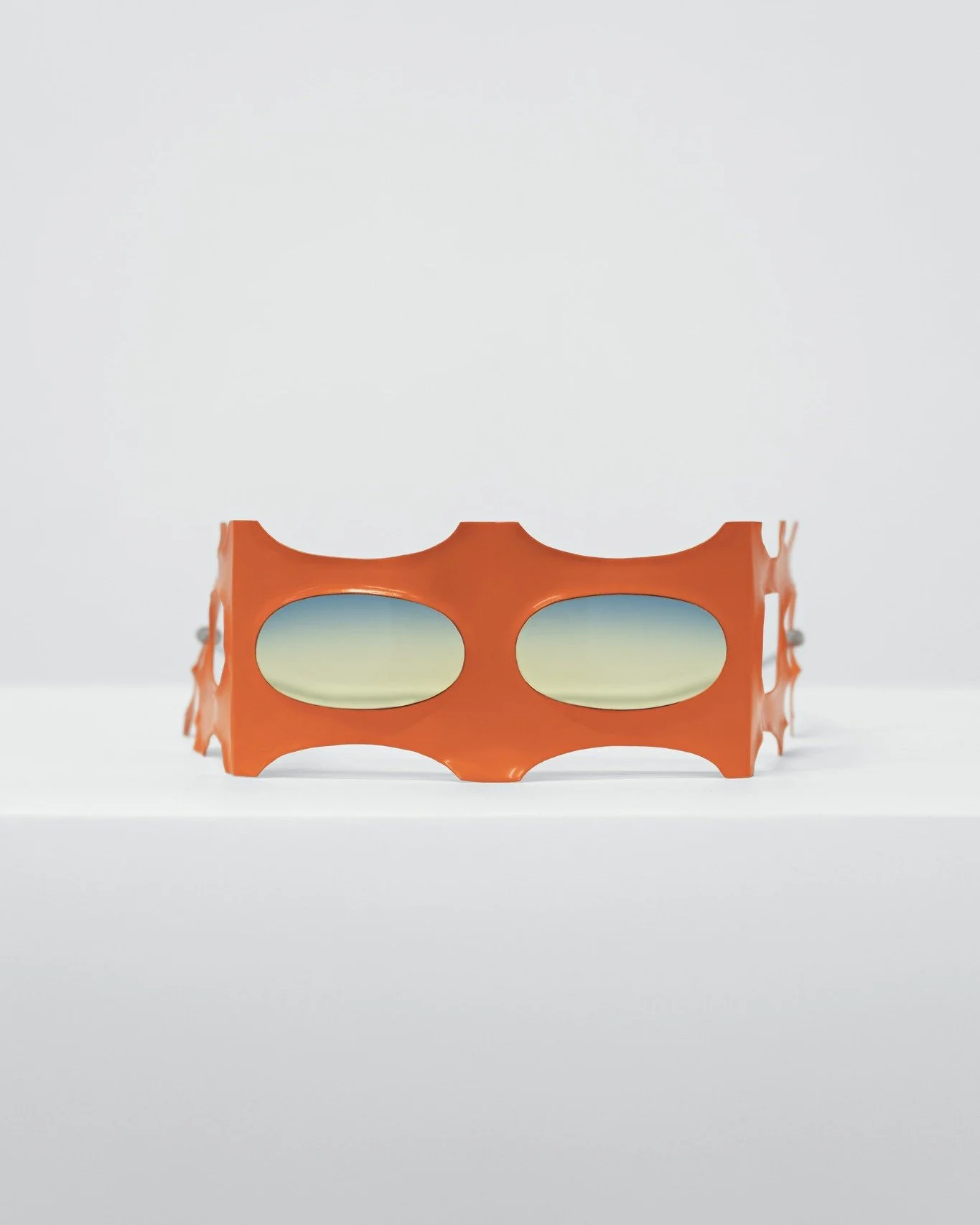
Yuhan Gu is a New York–based industrial designer whose work explores the intersection of function, emotion, and sculptural form. TACTO reflects Gu’s interest in the emotional relationship between people and the objects they keep close in their daily workspace. Designed as a cactus-shaped memo holder, the project transforms a familiar natural form into a playful and functional desktop object.