

10 Questions with Kevin J. Blade
Kevin J. Blade is an artist and creative technologist from Guayaquil, Ecuador, working at the intersection of music, technology, and social impact. His work has been selected by the 2026 IRCAM Forum (Centre Pompidou, Paris) and focuses on translating complex, invisible systems into accessible sensory experiences.
Blade is the creator of an audiovisual installation that uses real-time plant data and video-sonification to generate immersive performances. The project gained particular significance when it enabled a tempo-locked, multisensory experience for a deaf child, demonstrating how technological systems can expand access beyond conventional sound-based art.
His practice is shaped by both technical rigor and personal resilience, including recovery from a four-day coma, and is driven by a commitment to building new artistic languages rather than refining existing ones. Alongside his research-based work, Blade is an accomplished musician: he has performed piano at Teatro Sánchez Aguilar, one of Ecuador’s leading theatres, and has conducted a choir from the organ.
His ability to communicate complex ideas across disciplines has been recognized internationally, including a commendation for his English proficiency from former U.S. Ambassador David C. Mulford.

Kevin J. Blade - Portrait
ARTIST STATEMENT
"The Essentionalism" is a new art form that translates the inaudible language of nature into a synchronised audiovisual experience. Using bio-sensor technology, it captures the real-time biological data of living plants and transforms it into immersive soundscapes and live visuals. This work aims to facilitate what is complex by transcending technical limitations and sensory boundaries, creating a 360° experience that is both honest and essential. This is not just a performance; it is a live dialogue with the natural world, revealed at one's fingertips.
Escencia, Audiovisual Installation, Documentation, 2025 © Kevin J. Blade
INTERVIEW
First of all, can you tell us a bit about your background and how you first became interested in combining art, music, and technology?
My background is rooted in the constant tension between technical rigor and artistic need. I am currently completing my degree in Music Production at the Universidad de las Artes in Guayaquil, which provided me with deep expertise in audio engineering, acoustics, and the architecture of sound systems. This education provided the 'how', the precision required to build anything reliably. However, my true interest, which developed over the last decade, was sparked by a fundamental philosophical question: What is the essence of music when sound is removed?
I became acutely aware that the traditional music industry, for all its technical virtuosity, was becoming saturated. The emphasis was on refining an old language rather than creating a new one. The 'aha' moment came from realizing that while it is easy to make things complex, the ultimate creative challenge is to facilitate what is complex. I needed a way to strip away the noise and arrive at the 'essential.'
I began experimenting with bio-sensors not as instruments to play music, but as translators of unseen life. My work became about merging the silent, complex data of nature, specifically the real-time growth of a plant, with digital audiovisual systems.
Therefore, my interest isn't just a fusion of art, music, and technology; it’s a focused pursuit to create a universal sensory language. It is a direct reaction against the limits of the ear, aiming for a full, 360-degree experience that validates the essence of rhythm and feeling for every sense."
How did your personal journey shape the way you approach creativity and innovation?
My personal journey has fundamentally shaped my creative approach into one of radical problem-solving and rejection of the conventional path. Initially, my approach was defined by technical mastery, focused on perfecting the established musical grammar. However, a decade of experience and observation, culminating in my current academic work, showed me that success in the modern music industry is no longer about virtuosity, but about innovation. The ability to perfectly play an instrument is a commodity; the ability to create a new communication system is a unique vision.
This realization led to a pivotal shift: I stopped trying to excel within the existing process and started building my own. I spent years in a self-directed process I often liken to building my own museum, a curriculum focused entirely on solving one problem: How to translate complex, invisible reality into simple, human experience.
This journey shaped my approach to creativity in different ways, one of which was through embracing Certitude over Comfort. By doing this, I learned that true innovation is built on technical certitude. When incorporating the bio-sensor into my process, I faced 'technical hell' with software limitations. Instead of accepting the boundaries of existing tools, my approach became one of system architecture, building the necessary tools and protocols from the ground up to serve the artistic vision, regardless of difficulty.
The other strategy I used was focusing on the Essential. My failures in conventional performances (like struggling with a simple piano piece) reinforced my primary philosophy: Essentionalism. My innovation lies in deliberately stripping away the dominant sensory input (soundlessness) to force a more profound, universal engagement with the remaining senses. The ultimate confirmation of this approach came not from a congratulation or an award, but from seeing the system's profound impact on a deaf audience member. That human response, the genuine connection that overcame the sense of hearing, validated my journey and confirmed that my destination is not the sound stage, but the creation of a universal language.
Therefore, I approach creativity as an act of system building. My personal journey has taught me that the highest form of artistic freedom is the capacity to invent the rules of your own domain."

Interaction, Audiovisual Installation, Documentation, 2025 © Kevin J. Blade
What inspired you to create “The Essentionalism,” and what does this concept mean to you?
The inspiration for 'The Essentionalism' was born from a realization about the noise and sensory overload of the modern world. I was driven by a need to cut through the complexity of our digital lives and find a way back to a fundamental, honest truth. The specific mechanism was the observation of nature's silent complexity. I was fascinated by the constant, unseen biological processes happening beneath the surface, the bio-data, the electrical rhythms that drive life, yet are completely inaudible to us. The question became: If the music industry is obsessed with perfecting the sounds we can hear, what profound symphony are we missing in the things we cannot hear? This led to the creation of the system: using bio-sensors not to make a plant sound like a synthesizer, but to use its real-time data to sculpt a new, immersive, and universal sensory event.
For me, this concept is more than just a name; it is the design principle and the philosophical mission of my work. It was a Reaction to Virtuosity, a direct statement that innovation is essential while virtuosity is secondary. It is easy to make complicated music; it is difficult, and therefore essential, to make something that is truly simple, honest, and profound. At the same time, it means prioritizing the essential elements of human perception. By stripping away the dominant sense of hearing, achieving a kind of 'soundlessness', I compel the audience to engage all their other senses: the visual, the tactile, and the intellectual. The work forces a state of total, immersive presence. Ultimately, "The Essentionalism" is the pursuit of the core human experience. Its meaning is validated in the moment the art connects with anyone, regardless of their background or sensory capacity, proving that the language of rhythm and life is essential and universal. In short, 'The Essentionalism' is my attempt to build a museum of pure presence, translating the most complex, silent realities of life into the most simple and universally felt art."
How does the process of translating plant data into sound and visuals actually work?
Glad that you asked for it. First of all, I would like to invite you to envision a cascade with a constant flow of liquid. Once you recall that image, you will realize that human beings are identical to water. In fact, we are about 70% composed of it, and one interesting thing is that fingertips resemble raindrops. At the same time, we are certainly aware that plants are constantly in need of proper hydration, and this is precisely when the fact that humans are made of 70% water comes into play. Translating plant data into sound and visuals functions as an ongoing flow of water, where the raindrops (human fingertips) hydrate the plant through touch, activating its inner life (bio-data/electricity). Then, a transducer (bio-sensor) is employed to interpret this set of information. Consequently, a digital audio & video workstation (software) is used on a laptop to store that set of information and synchronize audio & visuals to provide coherence to the data video-sonification process. Finally, the digital audio & video workstation sends the data to a speaker and a video projector, respectively. All this happens in real-time.
The “singing plants” project had a strong emotional and social impact. How did it feel to see technology connect with people in such a meaningful way?
To put it succinctly, it means the world to me because every time I see people's reactions, whether it is excitement, surprise, confusion, or intrigue, it is a priceless experience. Actually, this reminds me of when I performed at my university library. A kid between the ages of 5 and 7 walked up to my audiovisual installation and started "making sing the flowers" over a rhythm track without losing tempo. After that, the kid leaves the installation happily jumping, and his mom saw him leaving the room and immediately approached me to say that she was very sorry because she thought her kid had a bad performance while "making the flowers sing" because of his son's hearing disability, but thankfully that was not the case. This was a shocking and life-changing experience for me. My initial plan was to impress the audience, but interestingly enough, I ended up being flabbergasted by this very same kid.
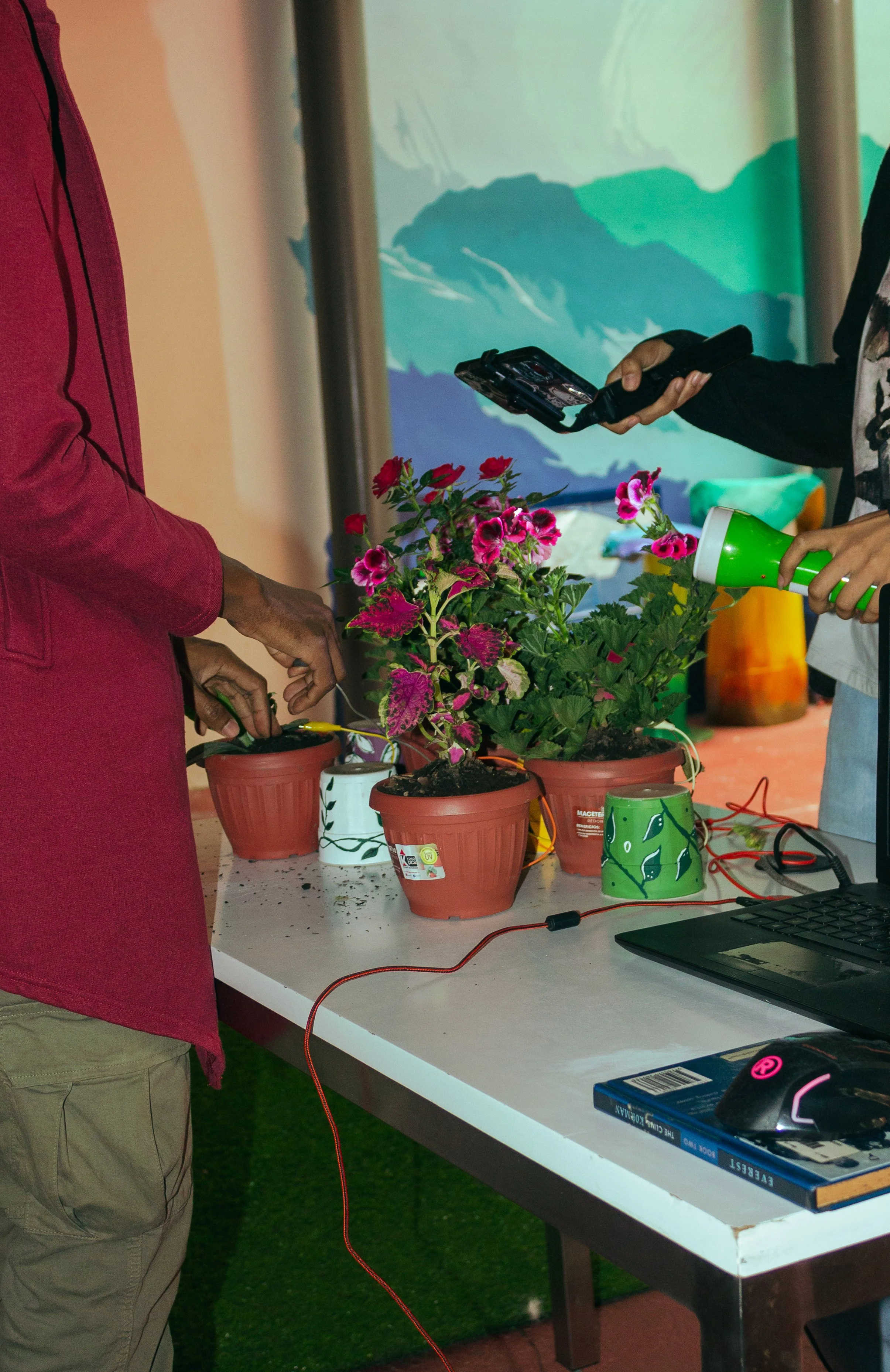
Flowers singing, Audiovisual Installation, Documentation, 2025 © Kevin J. Blade

Perspective, Audiovisual Installation, Documentation, 2025 © Kevin J. Blade
You have a strong background in music. How does your experience as a pianist and organist influence your artistic practice today?
Yes, I do. My journey as a pianist and organist has influenced me greatly. In fact, it is precisely the reason why I decided to launch this project (The Essentionalism).
I had the pleasure of conducting a small female choir at weddings, and after a performance, the mother of one of the choir members approached me and said: "Kevin, I truly appreciate your work with the choir. My daughter was able to sing thanks to you; she sings for you". After hearing that, I said to myself: No, that's not true, she used to sing already before meeting me. But, after all, I decided to take her compliment. 3 years later, I fully crafted "The Essentionalism" taking her compliment into consideration at an unconscious level to later realize that she was completely right. In fact, her daughter's name is Maria Rosario, which is Spanish for Rose Mary, and that is how the title "The man who makes the flowers sing" was born.
What role do you think technology plays in making art more inclusive and accessible to everyone?
It seems to me that technology aims to bring solar punk into existence. Solar punk is defined as the harmonious relationship between humans, machines, and nature. Therefore, I see a world where technology strives for cooperation, especially with those who struggle to navigate life.
Can you describe what a live performance of your work looks and feels like for the audience?
At first, the live mapping section is an eye-candy for most people due to the colors of flowers and plant-data being projected on the wall. At the same time, music is also an attractive feature of the performance because it reflects relaxation, which is absolutely benefitial for self-care. Last but not least, the interactive part of the installation is absolutely captivating since it is how the audience inmerse themselves in the performance, interacting as a main character coupled with the plants.
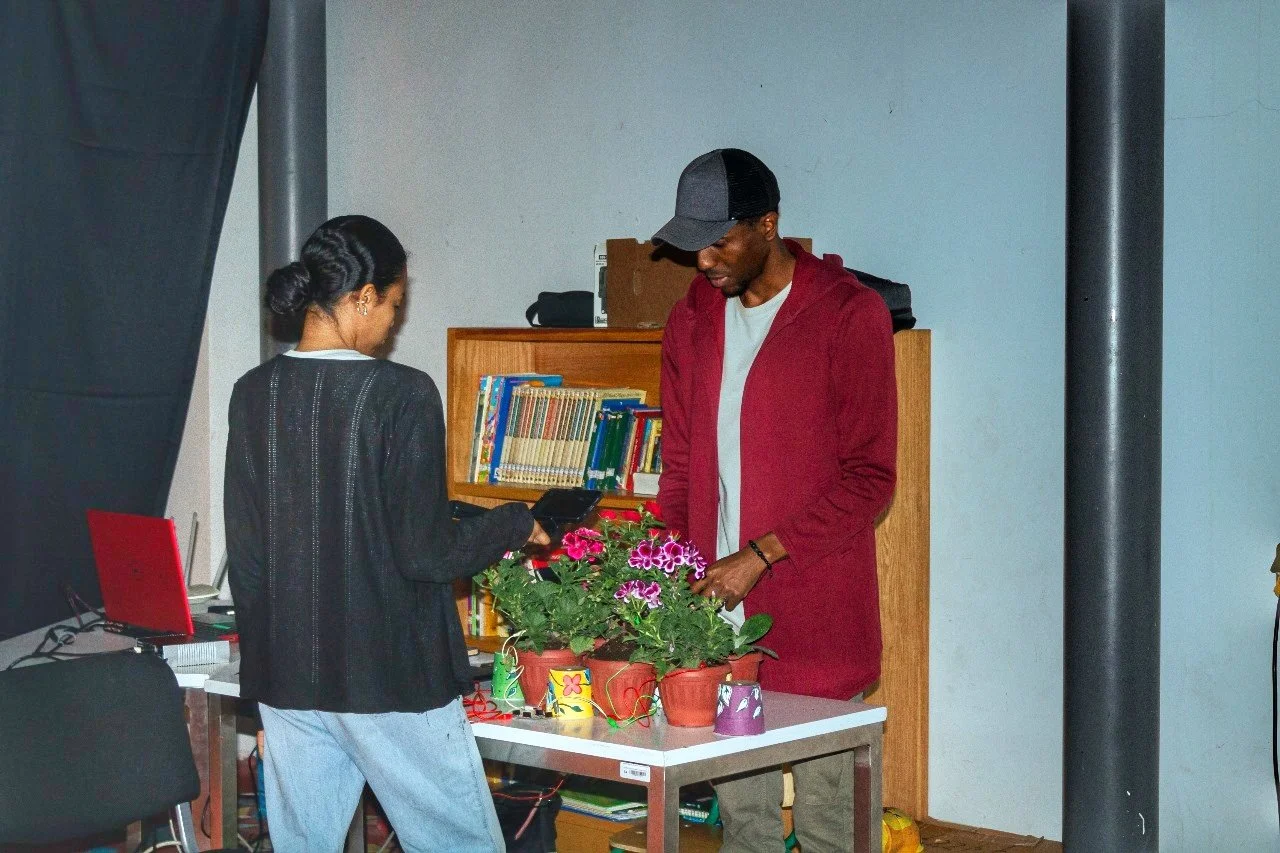
Essence, Audiovisual Installation, Documentation, 2025 © Kevin J. Blade
What message or feeling do you hope people take away from your installations?
I would like them to have a flashback from their childhood, a pleasing one, so that they can experience a sweet escape from all the hustle & bustle of their daily lives. I made this decision based on the idea of providing value through relaxation, as this particular state is vital for human life.
It seems to me that nothing deserves more attention than people's peacefulness since this is an invaluable asset and, thanks to technological & musical innovation, can now be secured for certain periods of time.
On the other hand, it may sound like a paradox to say that all the randomness rooted in data and nature is capable of bringing relief to our lives; however, this very same idea (randomness-relief) is what makes "The Essentionalism" so unique and so compelling because it facilitates what is complex in a fashionable manner. To sum it all up, relaxation would be the perfect term to describe it.
Lastly, what are you currently working on, and what new directions or technologies are you excited to explore next?
I would really like to explore the concept of “The camera obscura by Abelardo Morell´´ which provides the artist the opportunity to do some sort of live mapping without using any technological device. The camera obscura basically functions as a reflector, capturing all the details of a landscape that is located outside by using lenses, mirrors, etc, to project that very same scenery in a darkish room. At the same time, the Photo-sonification technique calls my attention in a great manner as it is another method of visual-sonification based on the data that every picture contains.
On the other hand, I am aiming to provide a whollistic experience to the user while being inmerse in my installation "Essentionalism" that is the reason why I will also plan to add a live sound technique called "Quadraphony" which basically means to place four different speakers at every corner of the installation to provide a 360° experience to the user sonically speaking.
Last but not least, programming is another activity that I aspire to pursue since I have been slightly familiar with Max for Live. This is a software that provides the capacity to fully create new sound & visual technological devices from scratch.
Artist’s Talk
Al-Tiba9 Interviews is a promotional platform for artists to articulate their vision and engage them with our diverse readership through a published art dialogue. The artists are interviewed by Mohamed Benhadj, the founder & curator of Al-Tiba9, to highlight their artistic careers and introduce them to the international contemporary art scene across our vast network of museums, galleries, art professionals, art dealers, collectors, and art lovers across the globe.
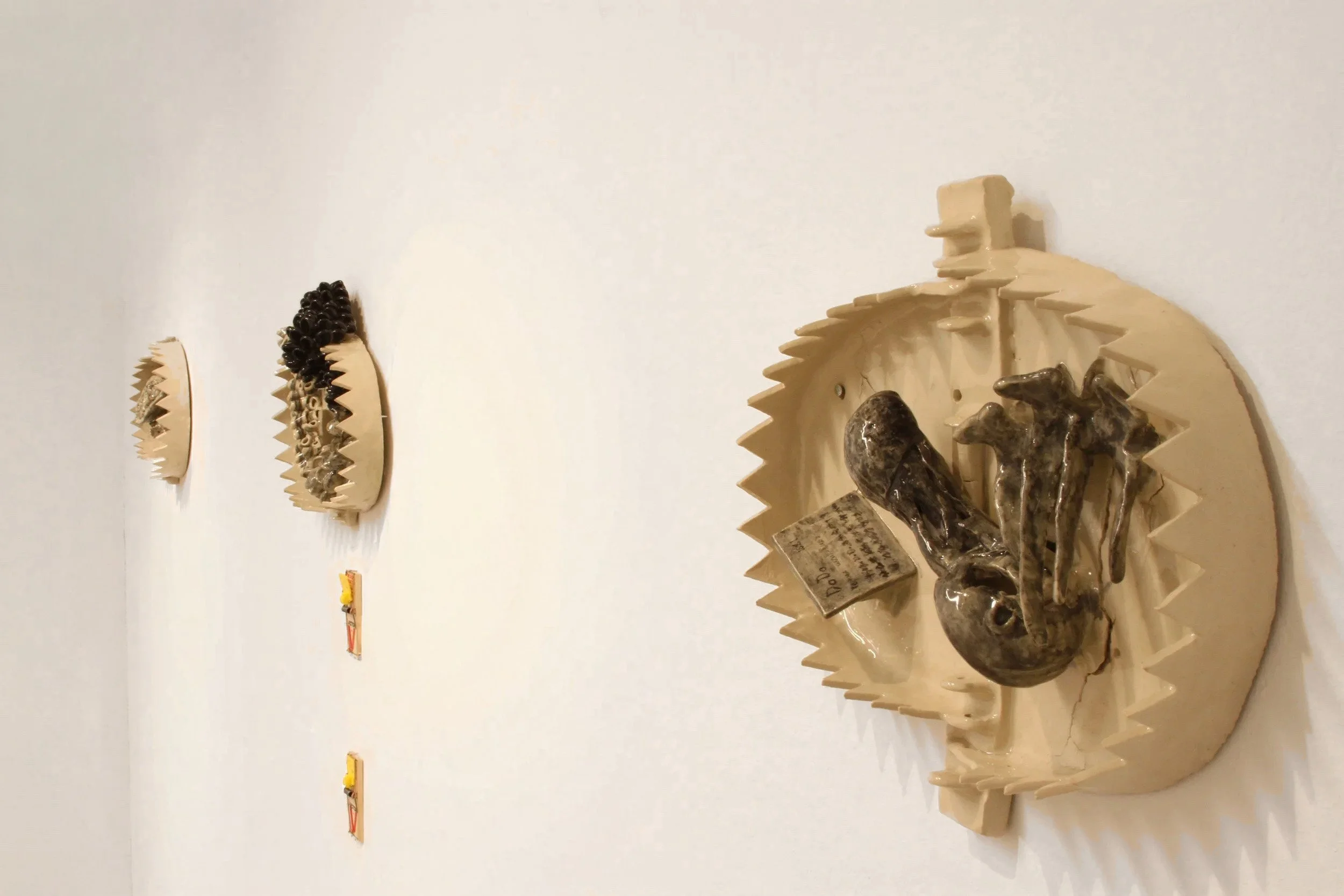



Lim Won Ji (Oneg) is a South Korean artist based in Chicago. Working across sculpture, installation, performance, and process-based experimentation, Lim investigates hypervigilance as a bodily condition shaped by anxiety, uncertainty, anticipation, and the desire for control, constructing unstable situations in which order is continually negotiated through gravity, time, repetition, and chance.