

10 Questions with Julian Newme
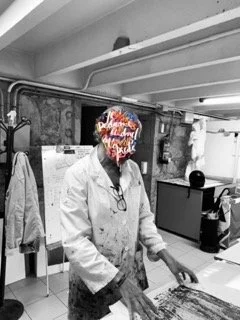
Julian Newme - Portrait
Julian Newme is a contemporary visual artist based in Vigo, Spain. His practice spans painting, digital art, printmaking, and hybrid visual formats, often incorporating text and image-based elements. Working across physical and digital media, his work reflects an ongoing engagement with contemporary visual culture and the emotional dimensions of experience.
Born in Galicia, Newme has an academic background in law and finance, alongside a long-standing involvement with culture, cinema, literature, music, and travel. His professional career in international business exposed him to diverse cultural contexts and ways of seeing, which gradually informed his artistic sensitivity and visual approach.
Through years of travel and close contact with contemporary art contexts, Newme has developed a visual language influenced by urban culture, abstraction, and expressive figuration. His work moves between large-scale paintings, digital compositions, screen printing, and experimental visual formats, with a particular interest in repetition, process, and the physical presence of images.
He currently lives and works in Vigo, where he continues to develop an evolving body of work rooted in experimentation, observation, and the intersections between visual art and contemporary life.
ARTIST STATEMENT
Julian Newme works across painting, digital media, and hybrid processes, approaching art as an ongoing act of exploration rather than a search for fixed outcomes. His practice is grounded in the necessity of making, staying close to the process as a way of observing, translating, and engaging with emotional and cultural experience through visual form.
His work moves between abstraction and figuration, allowing images to emerge, shift, and sometimes dissolve. Through repetition, layering, screen printing, collage, and image transfer, Newme constructs surfaces where gesture, memory, and fragments of contemporary life coexist. Rather than offering explanation or narrative, the work creates open spaces for perception and interpretation.
Music plays an essential role in his process, not as a medium in itself but as a constant presence in the studio. Rhythm, mood, and emotional tone influence how the work is built and how images develop over time. Text and visual elements often intersect as parallel languages, shaping the work without illustrating one another directly.
Newme is particularly interested in the encounter between the work and the viewer. His images remain intentionally open, inviting time, attention, and emotional engagement. Meaning develops through looking and feeling, rather than through instruction.
Scale is central to this relationship. Working in larger formats allows the work to acquire physical presence and weight, reinforcing its immersive and expressive qualities. Themes such as repetition, tension, intimacy and distance, rhythm, colour, and contemporary urban experience recur throughout his practice, forming a visual territory rather than a closed statement.
His work remains rooted in openness, an evolving practice that values attention, repetition, and the act of creation itself as a way of staying connected to experience.
Puddles, Mixed Media, 120x80 cm, 2025 © Julian Newme
INTERVIEW
You often describe yourself as a multidisciplinary artist, although the label feels limiting. How would you describe your practice in your own words?
I often reflect on what it means to inhabit the condition of being an artist. In recent years, this has taken the form of a persistent need for isolation, what some English academics describe as “aloneliness”: not loneliness in a negative sense, but a conscious desire to withdraw from social obligations in order to reclaim time for creation.
I experience an almost constant urgency to work. Ideas accumulate, and there is a strong need for direct contact with materials in the studio, away from external distractions. This state of creative restlessness, a tension between thought and action, is central to my practice.
I am not entirely comfortable with the term “multidisciplinary artist,” as it feels academically reductive. I do not approach disciplines as closed territories, nor do I aim to demonstrate technical mastery in a conventional sense. In reality, my focus is on investigating the relationships between materials, media, and languages, and seeing what kinds of surprises emerge from that manipulation.
At its core, my practice is image-based, sometimes conceptual, often expressive. I am interested in allowing experimentation, intuition, and process to lead, rather than predefined objectives or categories.

Alone, Mixed Media, 120x80 cm, 2025 © Julian Newme
You’ve explored many media over the years. How did this journey begin?
My relationship with art began very early, through a strong sensitivity to beauty and a desire to transform what I perceived. I was always drawn to images and their aesthetic force.
As a child, I drew constantly, but photography soon became central. I studied classical photography, immersed myself in manuals and monographs, and closely examined the work of major photographers. For many years, however, life circumstances led me to work outside the artistic field.
Around fifteen years ago, I entered the studio of a painter and began formal painting classes. That experience marked a turning point. From then on, I pursued artistic education through different paths and formats, culminating in my recent academic training in artistic screen printing.
Music runs throughout your work. How does it influence your creative process?
Music has always been fundamental to my life and remains central to my daily practice. It shapes my emotional memory and my perception of time.
I stay closely connected to music in many forms, maintaining contact with musicians and contemporary scenes, and attending live performances ranging from rock and alternative music to classical concerts, ballet, and other performative formats.
I always work with music. It conditions my emotional state and directly influences the rhythm and atmosphere of what I am making. Many of the texts that appear in my works originate from song lyrics I am listening to at the time, becoming part of the visual and emotional structure of the piece.
When you start a new project, do you begin with an image, a sound, a text, or a feeling?
The origin is always an image. Even when the initial trigger is a text, an abstract idea, or an emotion, it immediately becomes visual. I think, imagine, and project visually.
Text plays a decisive role in my work, not only for its meaning, but for its visual presence: typography, rhythm, handwriting, and spatial placement function as images in themselves.

Je Reclame Le Droit A L`ópacité, Mixed Media, 140x100 cm, 2025 © Julian Newme

Numbers, Mixed Media, 120x80 cm, 2025 © Julian Newme
You mainly work on large formats using acrylics and spray paint. What attracts you to these materials and scales?
I initially began working on aluminium for practical reasons, but it quickly became conceptually significant. Digital tools allowed me to develop a process based on repetition: generating images digitally, intervening physically with inks and sprays, re-digitising them, and repeating the cycle.
Aluminium enabled a fusion between painting and photography. Later, discovering screen printing opened new possibilities on this support and led me to study artists such as Robert Rauschenberg.
There are pieces that function well as a series of A3-sized prints or on canvases around 100 × 80 cm. However, the works most closely aligned with my current concerns demand larger dimensions. Scale intensifies both the emotional and physical experience and is becoming essential to my next steps.
Urban culture, travel, and contemporary life seem important in your work. How do these experiences enter your practice?
They are inseparable from who I am. I travel extensively, maintain an active cultural life, and feel deeply connected to urban environments and contemporary culture.
I document everything, films, books, artists, exhibitions, cities. I accumulate images and impressions almost compulsively. At the same time, this saturation generates a recurring need to withdraw, isolate, and focus exclusively on creation. This tension between overload and retreat is central to my work.
Your work moves between abstraction, pop elements, and digital references. How do you balance these different visual languages?
The question of style is a constant pressure, particularly in an era dominated by visibility. In my case, coherence does not come from control or balance, but from accepting contradiction as part of the process.
I am not selective in a restrictive sense. Different visual languages, abstraction, figuration, pop references, digital imagery, coexist in my work because they are all part of my personal and cultural experience. Even what I reject or resist eventually becomes material.
At the moment, I am especially drawn to silhouettes, physical presence, repetition, and text, while abstraction remains a foundational layer. Artists such as Agnes Martin guide me through their commitment to essence, restraint, and beauty, even as my own work continues to move toward image, colour, and multiplicity.

Restos, Mixed Media, 120x100 cm, 2025 © Julian Newme
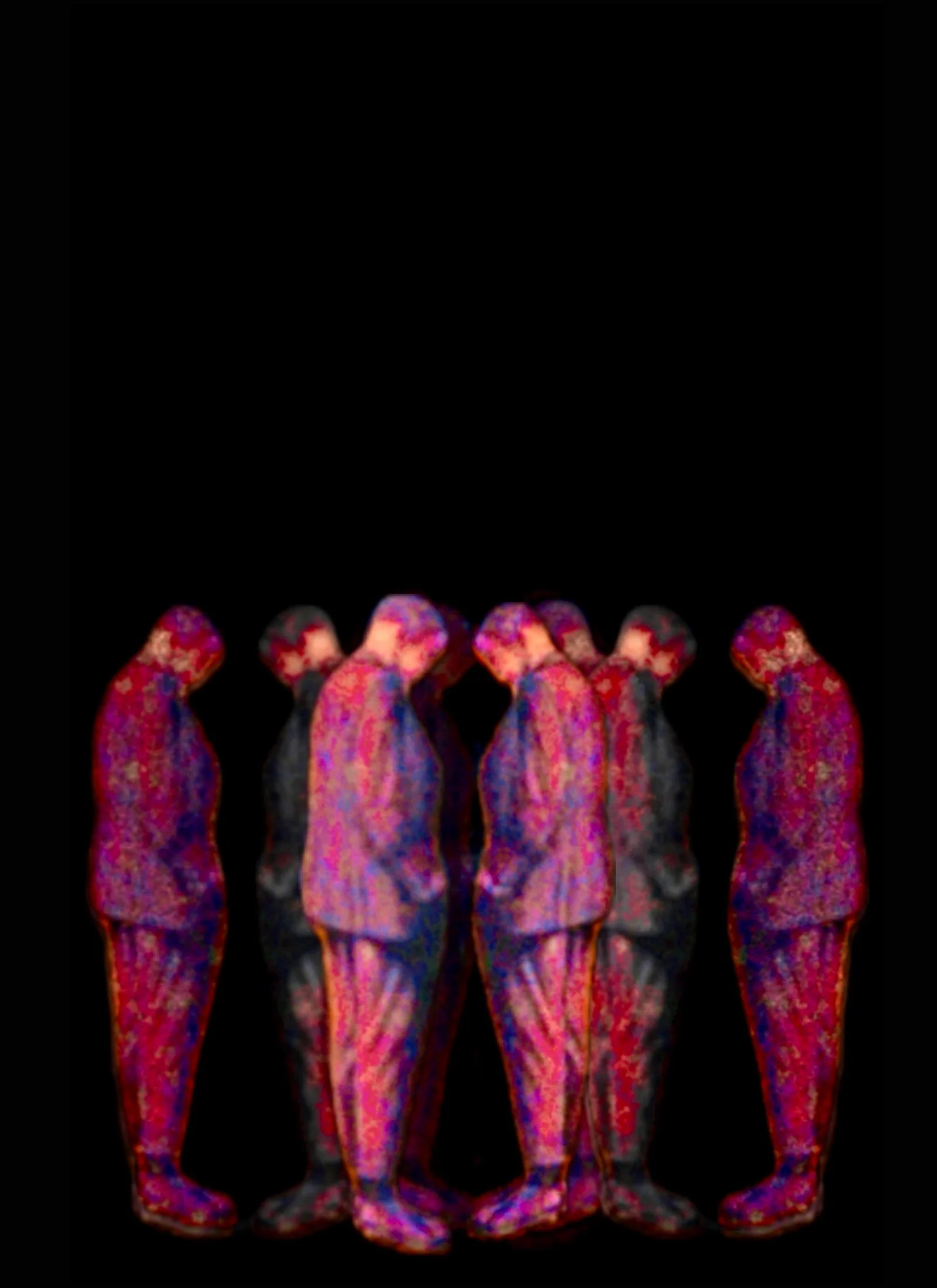
Restos, Mixed Media, 120x100 cm, 2025 © Julian Newme
You’ve worked independently and with mentors. What has this given you as an artist?
My trajectory within the professional art ecosystem is still relatively recent. A decisive experience was spending three years in the studio of a painter who helped me focus and fully commit to a creative life.
Later, enrolling in the School of Arts and Crafts in Vigo for my degree in Artistic Screen Printing provided an environment of collective effort, technical rigour, and shared experimentation.
At the same time, I have largely been my own mentor, supporting my education and practice through other professional activities. This autonomy has allowed me to develop my work without waiting for external validation.
You often move between artistic and more commercial projects. How do these two areas influence each other?
Visibility is a condition of the current context, even if it sometimes sits uneasily with me. Some parts of my production, particularly digital prints, circulate more easily and reach a broader audience.
Earlier in my practice, I worked on pop portraits, album covers, video lyrics, and commissioned projects for public or commercial spaces. These experiences were formative and helped sustain my activity.
I understand all of this as part of the same path. Each project contributes, in different ways, to the conditions that allow me to continue working and to move forward artistically.
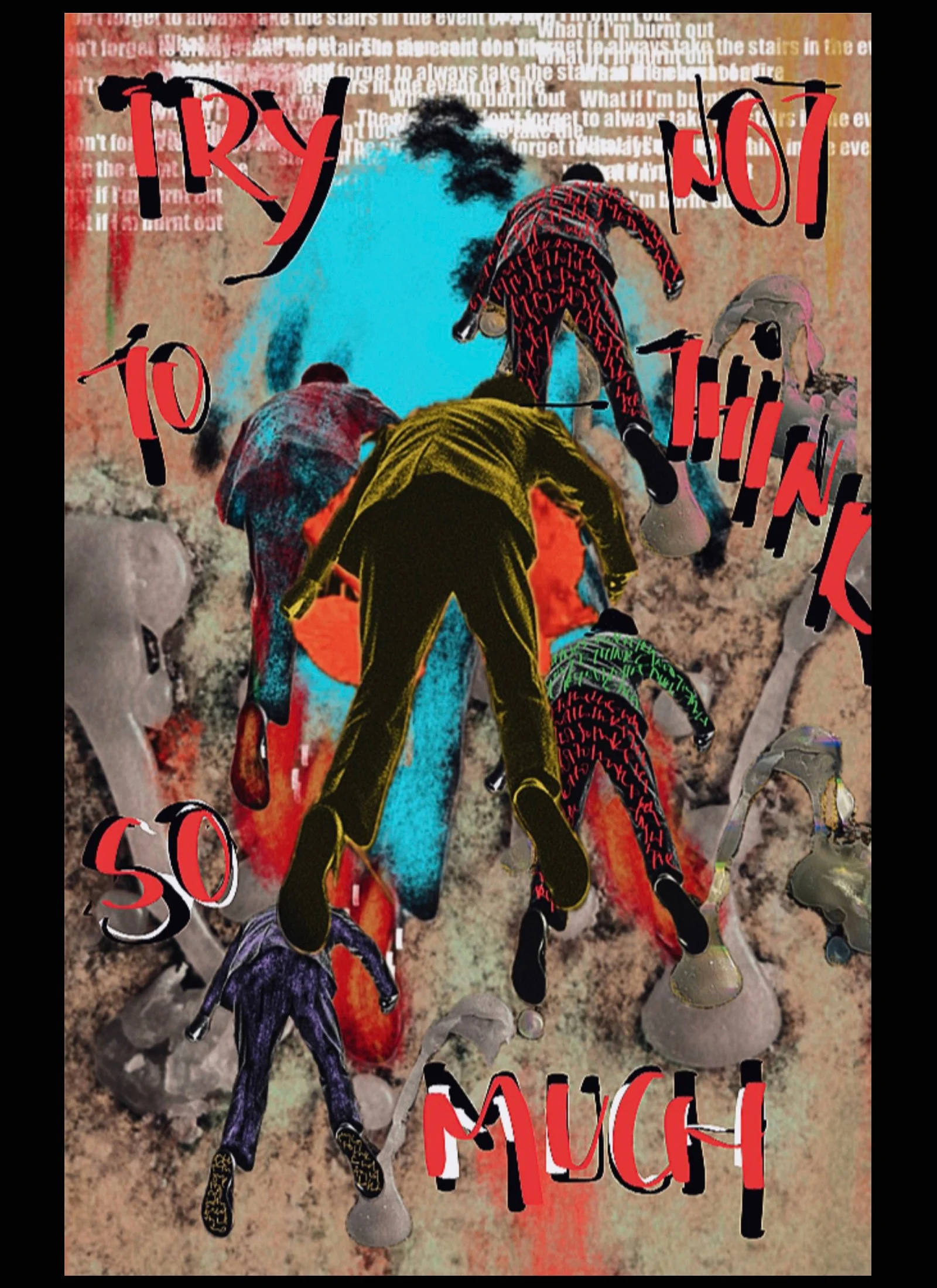
TNTTTM, Mixed Media, 120x80 cm, 2025 © Julian Newme
Lastly, what are you currently working on, and what would you like to explore next?
I am currently developing my final degree project in Artistic Screen Printing, titled Restos, Naufragios, Errores y Repeticiones, scheduled for exhibition in November 2026.
The project was initially conceived and presented as a unique artist’s book, which is currently exhibited at the School of Arts and Crafts. The book brings together visual material, printed elements, and conceptual structure, with aluminium used for the cover and key printed components. This book functions as both an autonomous work and the conceptual foundation of the wider project.
The ongoing development expands this initial format into medium- and large-scale works on aluminium, incorporating screen printing, cyanotype, and physical intervention, alongside the production of a limited-edition process publication. Balancing the material demands of the physical works with the time-intensive nature of the book has become one of the central challenges of the project, and an integral part of its meaning.
In the coming months, my focus is on consolidating this body of work, continuing to develop new pieces, and presenting them in supportive exhibition contexts. More broadly, my priority is to preserve time, attention, and space for sustained artistic work, allowing the practice to grow through continuity rather than acceleration.
Artist’s Talk
Al-Tiba9 Interviews is a promotional platform for artists to articulate their vision and engage them with our diverse readership through a published art dialogue. The artists are interviewed by Mohamed Benhadj, the founder & curator of Al-Tiba9, to highlight their artistic careers and introduce them to the international contemporary art scene across our vast network of museums, galleries, art professionals, art dealers, collectors, and art lovers across the globe.


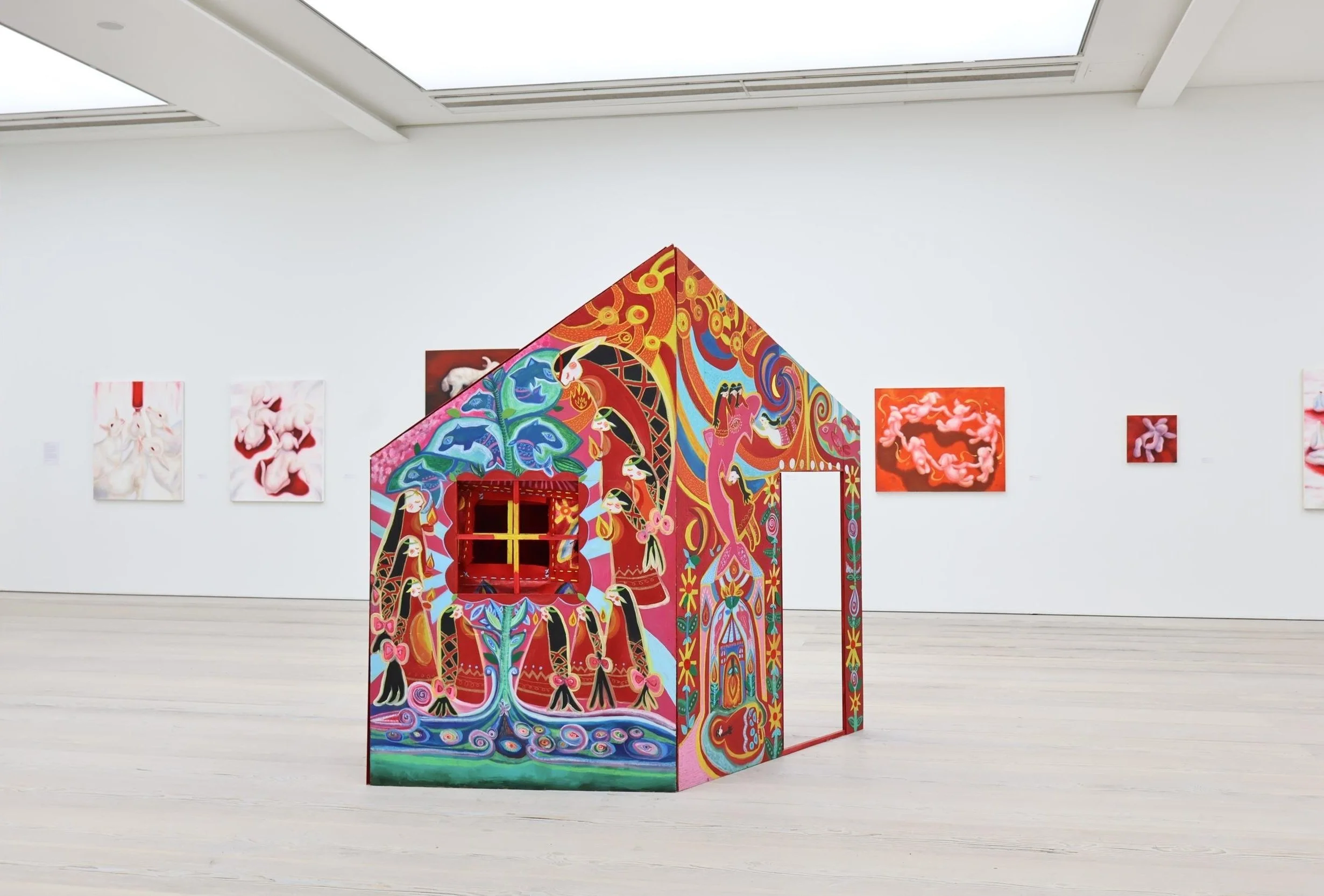


Yuhan Gu is a New York–based industrial designer whose work explores the intersection of function, emotion, and sculptural form. TACTO reflects Gu’s interest in the emotional relationship between people and the objects they keep close in their daily workspace. Designed as a cactus-shaped memo holder, the project transforms a familiar natural form into a playful and functional desktop object.