
10 Questions with Anastasiia Ulianytska (Why.Not.Me)
Why.Not.Me is a conceptual artist based in the Scottish Highlands whose practice emerged from the profound experience of displacement. When life was forced to fit into a single bag, the stability of a stationary studio and delicate, paper-based mediums became a luxury of the past. In their place, she began creating "wearable artifacts", portable sanctuaries designed for the modern nomad.
Her signature series, "Armours of Meanings," sits at the intersection of urban brutalism and ancient protection rituals. Drawing inspiration from the raw, unyielding textures of metropolitan landscapes, Anastasiia treats textiles not as fashion but as structural sites of memory and resistance. Building on a technical foundation of formal script-writing that began at the age of thirteen, her current asemic calligraphy has evolved into a tool for concealment. By abstracting curated lyrics and profound quotes into encrypted, illegible patterns, she creates a protective layer for the soul, ensuring that the core of her message remains an unyielding secret within the cloth.
Her practice is defined by bold technical experimentation, integrating 3D elements, industrial textures, and unconventional imprints, such as microscopic glass slides, to create multi-layered surfaces. By working with negative space and light-reflective pigments, she creates "Art to Carry" that reacts to the environment, mirroring the fluid nature of identity.
As noted by curator Michael Hannah, her work is a "rebellion born from silence." Having exhibited in London and Geneva, Why.Not.Me’s practice serves as a testament to resilience. Through her art, she reinterprets vulnerability as a structural strength, proving that even when everything else is left behind, identity remains an unyielding shield.
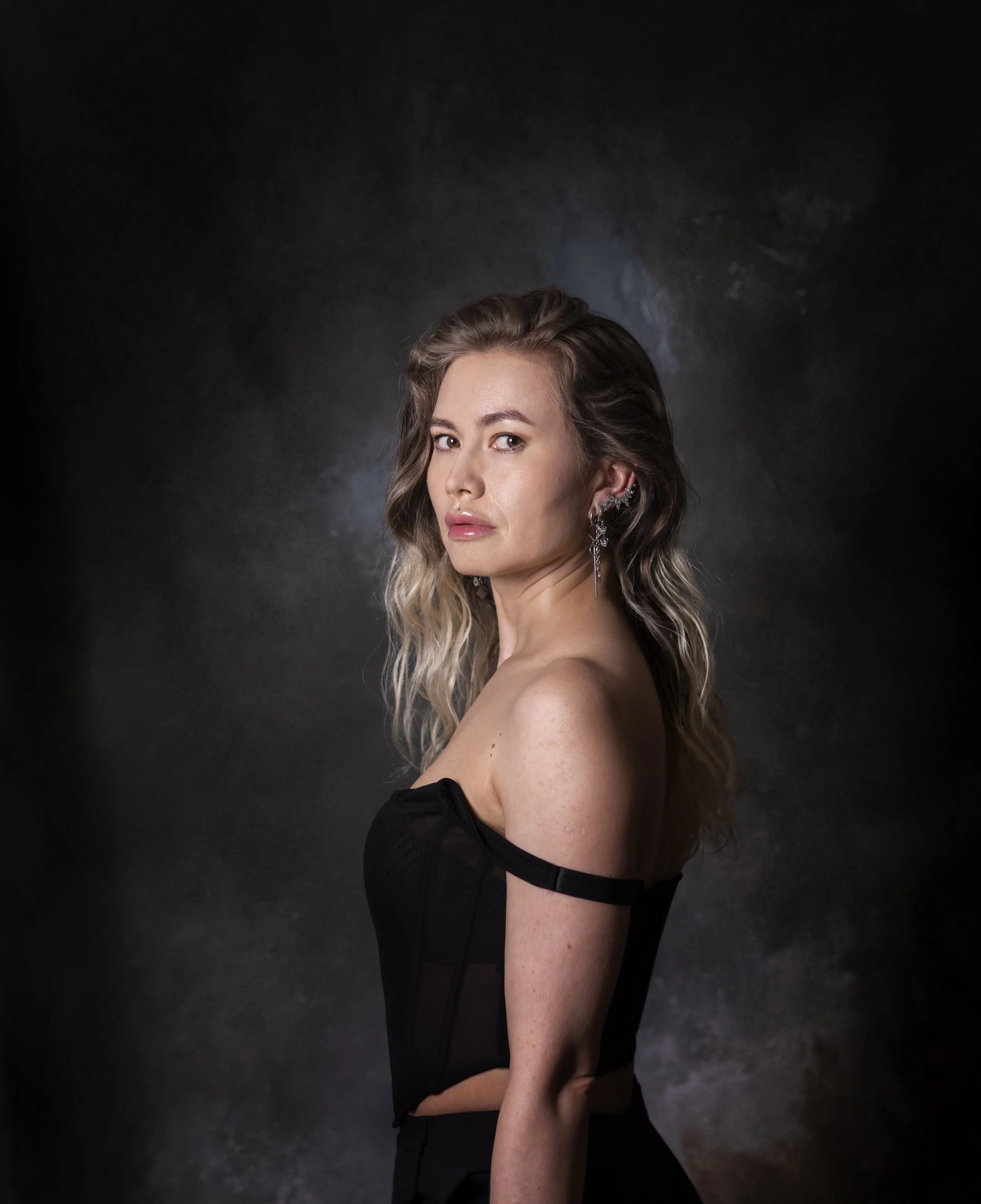
Anastasiia Ulianytska (Why.Not.Me) - Portrait
ARTIST STATEMENT
“My practice is a rebellion born from silence and the necessity of survival. I transform textiles into the "Armours of Meaning", portable sanctuaries designed for the modern nomad. My choice of clothing was catalyzed by my displacement from Ukraine; when you must fit your entire life into one small bag, art must become portable to survive.
I believe that art should not be a static observation hidden in a house, but a living intervention in the streets. Clothing is a universal necessity, yet through my work, it becomes a unique shield of identity and a gift of gratitude. Utilizing asemic cyphers, I create "Art to Carry", pieces that remain unfinished until they breathe with the wearer and are seen by the world. In a chaotic reality, I choose to be the encrypted frequency, proving that even when we leave everything behind, our identity remains on our backs.
"Art is the only way to run away without leaving home." — Twyla Tharp
For me, art is a way to forget that I cannot return home. My project, the "Armours of Meaning" series, is a search for order within chaos. I transform personal vulnerability into structural strength, creating wearable sanctuaries from textile, 3D liners, and duochrome pigments. My practice is 100% manual and human-driven, reflecting a commitment to the tangible, tactile reality of survival and hope.”
— Anastasiia Ulianytska (Why.Not.Me)

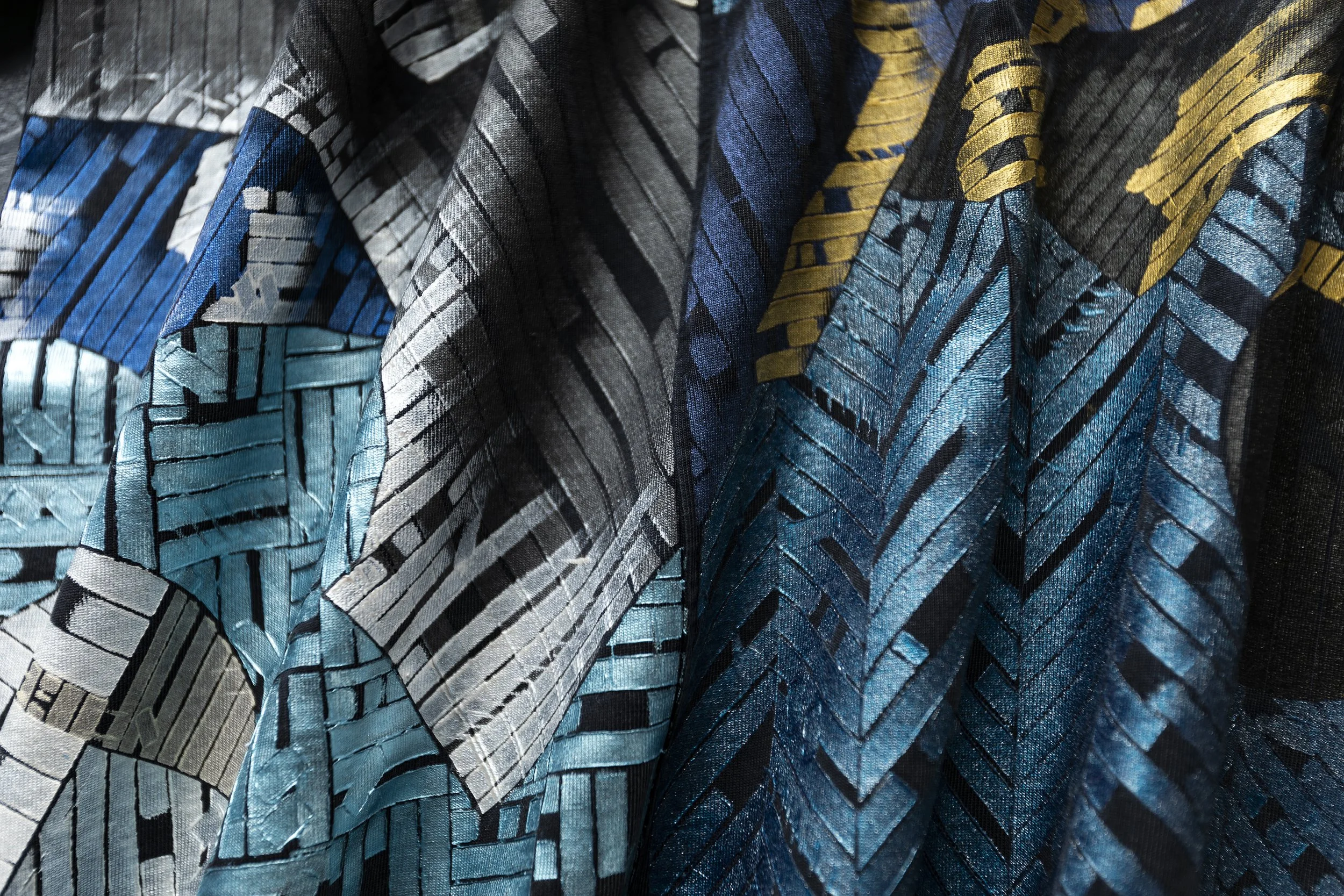
37, Acryl on textile, 73x92 cm, 2025 © Why.Not.Me
INTERVIEW
First off, you began creating art after being displaced from Ukraine. How did that moment reshape your idea of what art could be?
Before the displacement, art for me was more about meditative hobbies, watercolors, cross-stitching, or beadwork. I wasn't particularly skilled at landscapes, but I found peace in the process. However, I always had an obsession with handwriting. From the age of thirteen, I began constantly refining it, which was a challenge in the high-pressure environment of my Ukrainian 'gymnasium' class, where we had heavy workloads and endless dictation. Looking for flaws in my work and trying to fix them is simply part of my nature.
A week before the war started, I broke my ankle, leaving me in a very vulnerable position. When I had to flee, I packed lightly: documents, a few clothes, my favorite perfume, and a cage with my two guinea pigs. I left all my hobbies behind, taking only a notebook and calligraphy markers. During the journey to Krakow, I relied heavily on the help of others, which deeply challenged my sense of independence.
Living in a foreign place, I felt unsettled; my suitcase was never fully unpacked, always ready for the next move. I missed my creative outlets, but I was caught in a limbo: 'Should I buy a watercolor palette or not?' If I bought paper and paints, they would become a physical burden if I had to move again. This overthinking led me to a realization: art needed to be as portable as life itself.
Clothing is an essential part of our existence and easy to carry. I thought, 'Why not use it as my canvas?' My first attempts were terrible, but I loved them anyway. When people on the street began asking where I got them, I realized I had found something meaningful. Art was no longer something to be kept in a studio; it became something to be worn, carried, and lived in.

37 (detail), Acryl on textile, 73x92 cm, 2025 © Why.Not.Me
The idea of fitting your life into one bag is powerful. How did it lead you specifically to wearable works?
Fitting my life into a single bag was never a curated 'idea'; it was a stark necessity. There is a profound difference between choosing to downsize or immigrate and being forced due to circumstances beyond your control. For several months, those few possessions were my entire world. I found myself hesitant to acquire anything new; the original items became 'anchors', tangible fragments of the home I had left behind.
This reality naturally led me to wearable art. When your physical environment is unstable, your clothes become your most reliable sanctuary, a portable architecture. Many who connect with my work share this experience of being in flux. For us, art that you can wear is more than an aesthetic choice; it is a practical way to carry your identity, your history, and your 'home' with you, no matter where the journey leads.
Why did textiles become your primary medium, instead of returning to more traditional formats like painting?
As I mentioned earlier, traditional canvases are inherently static; they demand a stable environment and a permanent wall. When you are living with the uncertainty of not knowing where you will be next year, or where your next 'home' will even be, traditional formats become a burden.
I realized that gifting a large canvas to someone in a similar situation is almost a disservice. It’s a beautiful object, but it doesn’t fit into a suitcase; it’s difficult to carry and easy to lose in a transition. Wearable art, however, is the perfect solution for a life in motion. It doesn't demand extra space; it simply exists alongside the other items you wear every day. By choosing textiles, I ensured that my work and the energy I put into it would always stay with the person it was meant for, no matter where they went next.
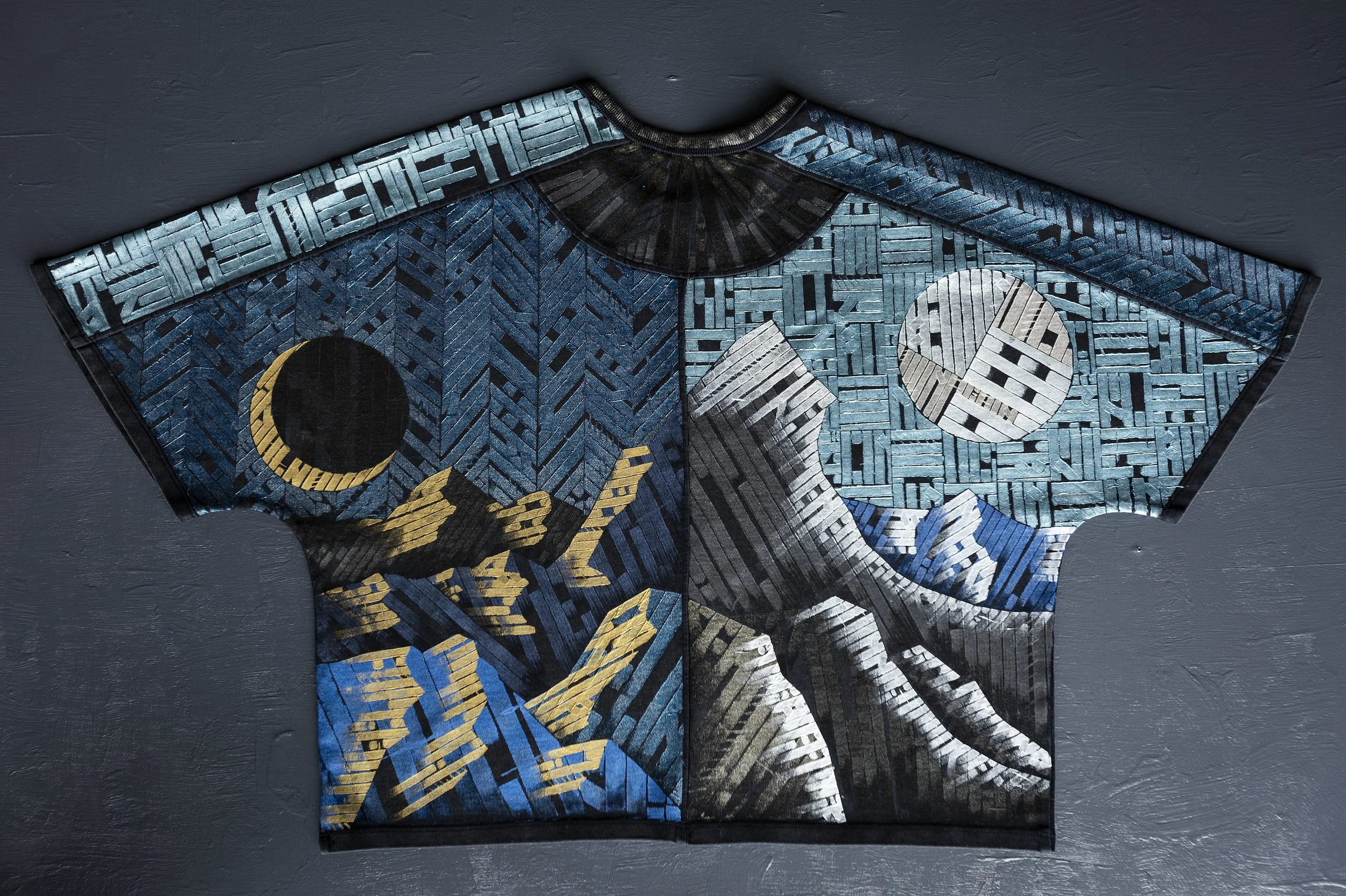
39, Acryl on textile, 61x103 cm, 2026 © Why.Not.Me
39 (detail), Acryl on textile, 61x103 cm, 2026 © Why.Not.Me
Can you describe how a piece from the “Armor of Meanings” series comes into being, step by step?
My process is a transition from accidental observation to systematic execution. It sometimes starts with an idea found in the mundane. I find myself captivated by patterns on everyday objects, the texture of a trash bin (№24), the weathered surface of outdoor furniture (№23), or the unique 'cut' of a garment that I can 'play' with (№39).
Stage 1: The Blueprint. I begin with sketches to visualize the final result. Sometimes it’s a straightforward path; other times, I rework the concept several times until it feels right. Inspiration strikes in the most unexpected moments. Once, during a visit to a sauna, I became so captivated by the intricate pattern of the small wall tiles that I had to rush for paper and a pencil to sketch it while everyone else was relaxing. I was terrified of losing that specific visual frequency (this became Artwork №16).
Stage 2: The Grid. I prefer working with heavy, thick cotton as my canvas, or sometimes denim or linen. To maintain control over the composition, I use tailor's chalk or soap to create a square mesh. This grid allows me to position elements precisely and keep the edges of the patterns sharp. I map out the entire artwork with these temporary lines to understand the spatial relationship between the elements before the first drop of paint touches the fabric.
Stage 3: Controlled Chaos. I use masking tape extensively. It serves two purposes: it ensures architectural precision in the lines and acts as a boundary for my creative flow. I tend to get carried away in the moment, and the tape reminds me where a specific element, color, or brushstroke should stop. It’s my way of maintaining a dialogue between human spontaneity and structural discipline. Over time, while developing my style, the technical execution has become significantly more complex and strictly sequential. My process now resembles a linear chain of dependencies: one element cannot be initiated until the previous layer is completely dry. Because the pigments I use are rich and tactile, they are easily smudged, demanding immense patience. To maintain this focus, I work in a loop, often listening to specific music on repeat to anchor myself in the flow. The asemic calligraphy I apply is frequently rooted in specific lyrics or quotations that I find perfect for that exact piece. However, there is no need for the world to know exactly what is written there. It is a private dialogue between me, the artwork, and the future owner. 'If you know, you know.' It is the encrypted soul of the Armor.
I often apply multiple layers to achieve the desired depth and coverage. Some of my artworks become quite heavy; I like to joke that they are literal armors, and that the wearer is carrying all the effort and energy I put into the piece with them. Some brushstrokes are layered so thickly, reminiscent of an impasto technique, creating a rich, tactile texture that invites touch.
In my negative background pieces (№31), the calligraphy is created by the tape itself. I paint the unmasked areas, meaning the actual artwork remains hidden until the very end. There is a high level of suspense here; you cannot 'undo' or 'peek' under the tape to see if the paint has bled. You have to trust the process entirely. This ritual of removing the tape after hours of 'blind' work is a vital emotional moment for me; it’s the revelation of the cypher.
Experimental Techniques: Currently, I am expanding this dialogue by experimenting with laboratory glass slides to create imprints. This creates a delicate, watercolor-like effect that I find particularly useful when working with negative space. By separating the slides in a specific way, I can initiate the formation of dendritic fractals within the paint.
Another area of investigation is the expansion of my materials. I have recently experimented with thermochromic pigments, which react to touch and change color. However, they are quite tricky to maintain: excessively high temperatures damage them irreversibly, while my other paints require ironing to fix them to the fabric. Additionally, I aim to achieve the 'blackest black' and a liquid crystal effect (a rainbow reaction to touch) in my textile calligraphy one day, but that is a long-term journey.
Another ongoing direction is the integration of physical objects into the fabric. For instance, in artwork №25, I hand-sewed metallic leaves into the composition. I am currently working on new pieces involving intricate flowers and lace. This is a slow, meditative process, sewing each element by hand takes a long time, but it adds a final layer of 'protection' and unique character to the Armor.
I have taken the liberty of attaching several process photos to illustrate my descriptions. I often find myself falling victim to the 'curse of knowledge', where a process seems perfectly clear in my mind because I live it every day, but my words might fail to capture its physical reality. I believe that sometimes showing is indeed better than telling.
Of course, due to my hypersensitive nature, I struggle immensely during this process. It involves observing the work for long periods from different angles and in varying light, often asking those around me, 'Please, hold it like this for a minute,' while I stare, trying to discern if the piece truly resonates. The apogee of this struggle occurs when something goes wrong: a color shifts unexpectedly after drying, a line lacks precision, or a brush is accidentally dropped. In those moments, I often find myself lying on the floor in total despair. Yes, textile is indeed unforgiving, and my perfectionism suffers, but at the same time, it is through these moments that I am learning to accept.

31, Acryl on textile, 56x88 cm, 2024 © Why.Not.Me
Your use of unreadable calligraphy feels both personal and coded. What role does writing play in your work?
For me, applying calligraphy to garments is akin to creating a modern artifact or a protective charm. I recently received feedback suggesting that my work functions as a 'modern vyshyvanka,' which provided a profound new perspective I hadn’t considered before.
In Ukrainian culture, the vyshyvanka is a traditional shirt featuring intricate embroidery, traditionally cross-stitched or using satin-stitch. Since ancient times, these patterns were never merely decorative; they were encoded with protective symbols and ancestral meanings. I have come to see my work through this lens: the time and effort invested in each piece transform the process into a meditative ritual. Every stroke of my asemic script serves as a modern equivalent to those traditional patterns, a way of 'weaving' protection and personal intention into the fabric. It is a slow, devoted labor where the script becomes the encrypted soul of the garment.
You describe your garments as both protection and vulnerability. How do these two states coexist in a single piece?
To me, the connection is innate: the necessity for protection only arises because a core of vulnerability exists. Conventionally, vulnerability is mislabeled as a weakness, something to be obscured or guarded against perceived attack. I challenge this notion. I believe that while we must protect our vulnerability, we should also wear it as a mark of distinction.
Exposing one's vulnerability is a testament to profound bravery, the courage to reveal our true selves in a world that demands perfection. My work embraces the 'perfectly imperfect.' It is an admission that we are, after all, simply human. By creating armor that is itself a piece of art, I am asserting that our fragility is not a flaw to be hidden, but a strength to be celebrated. We are all masterpieces of our own circumstances, perfect exactly as we are.
The concept of “Art to Carry” suggests movement and intimacy. How do you imagine the relationship between the work and its wearer?
For me, 'Art to Carry' is deeply rooted in the concept of connection. Most of my pieces were originally created as gifts for the meaningful people in my life. All things must have an end. We live in a reality where paths constantly diverge; people move to different cities and countries. We have the freedom to travel anywhere in the world, yet we often cannot return to where we truly want to be, because that place no longer exists, either physically or in the dimension of time.
My work serves as a token of appreciation for those who remain. I’ve always found it difficult to find 'my people'; I’ve always been a bit of an outsider, a 'weirdo' perhaps, and I’ve made my peace with that. Because of this, when a true connection happens, I treasure it immensely.
By gifting an artwork that is worn close to the body, something covered in my physical effort, time, and paint, I am offering a language that goes beyond words. It’s a way to express how important a person is to me through a tactile, intimate presence that stays with them, even when our paths separate.

13 (detail), Acryl on textile, 93x44 in, 2023 © Why.Not.Me
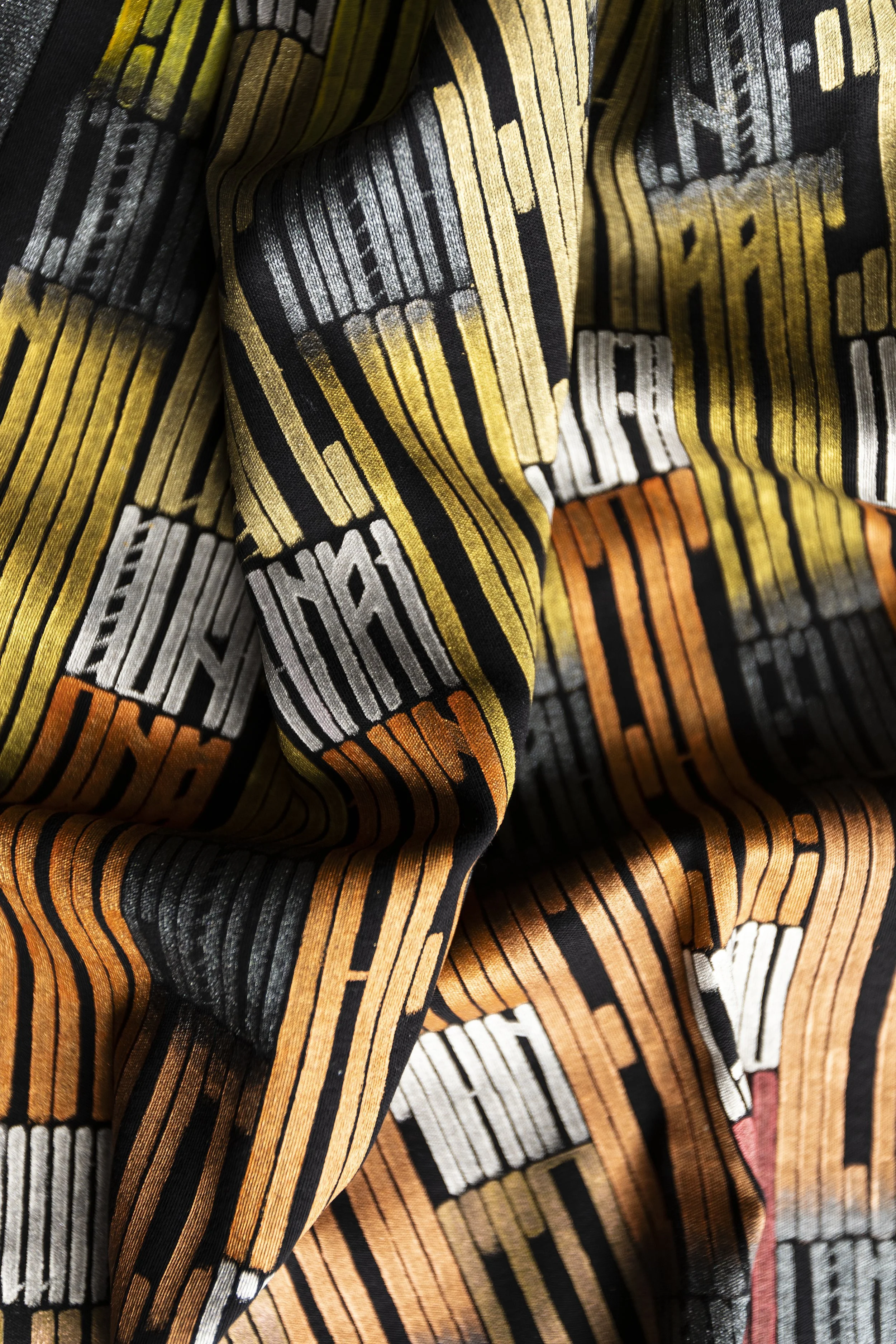
23 (detail), Acryl on textile, 50x63 cm, 2023 © Why.Not.Me
You embrace decay as part of the work. What does time add to your pieces that you cannot create yourself?
That is a fascinating perspective. Time adds a layer of authenticity that I simply cannot replicate in my studio. While I can mimic distress or simulate ageing, there is something irreplaceable about the organic wear that comes from a person’s life.
You never know exactly how someone will interact with a piece. For instance, if someone has a favorite cross-body bag, the constant friction causes the pigment to degrade in a precise map of their daily movements. Similarly, the habit of tucking a shirt into jeans creates unique traces. Some people wear the work so intensely that they eventually return to me for repairs. I find those reunions deeply moving, meeting my work again after a long absence and seeing the 'scars' it has gained from its journey. Conversely, some owners have more delicate habits, and their pieces remain virtually pristine even after frequent wear.
Then there are the collectors who treat the work as a museum artifact, keeping it behind glass or in its gift box out of fear of damaging it. While this is contrary to my manifesto, that art belongs to the streets and the rhythm of life, not a storage unit, I’ve learned to respect that choice. Once the work leaves my hands, the owner becomes its guardian, and I have no right to dictate how they should experience it.
Your works avoid traditional titles and use numerical sequences instead. What does this “radical privacy” allow you to preserve?
There is a certain irony in it: I put so much effort into transforming my handwriting into something unreadable that most people perceive it simply as abstract lines. But that is exactly the point. The numerical sequences and the script's asemic nature act as a filter.
This 'radical privacy' preserves the core of my experience. In a world that constantly demands explanations and expects everything to be 'consumed' and understood instantly, my work refuses to be fully transparent. Using numbers instead of titles helps me avoid imposing a specific narrative on the viewer. It allows the work to exist as a pure artifact, a record of a moment that belongs to me, while the viewer is left with only the visual rhythm. It’s a way of saying: 'You can see my armor, you can even wear it, but the secrets it protects remain mine unless and until I choose to share them.' Perhaps it is radical, but in our current reality, keeping something for yourself is a necessary act of rebellion.

41, Acryl on textile, 56x88 cm, 2026 © Why.Not.Me
Lastly, looking ahead, do you see your practice expanding into new forms or contexts, or staying rooted in wearable artefacts?
As the saying goes, 'never say never.' Honestly, I don’t have a definitive answer. Similarly, if you had asked me five years ago about living abroad, I would have said it was impossible, I was afraid of change and flying. However, circumstances often compel us to adapt and find strength in places we never expected.
There are still so many ideas waiting to be brought to life in fabric that I hope to one day. I find textiles to be a challenging and unforgiving medium; it doesn’t allow for easy corrections, which pushes me to embrace imperfection. Since the materials for painting on textiles are limited, I am constantly experimenting. For me, that struggle is the most rewarding part of the process. Perhaps I simply don't like it when things are too easy (joking, but perhaps there’s some truth to it).
Artist’s Talk
Al-Tiba9 Interviews is a promotional platform for artists to articulate their vision and engage them with our diverse readership through a published art dialogue. The artists are interviewed by Mohamed Benhadj, the founder & curator of Al-Tiba9, to highlight their artistic careers and introduce them to the international contemporary art scene across our vast network of museums, galleries, art professionals, art dealers, collectors, and art lovers across the globe.


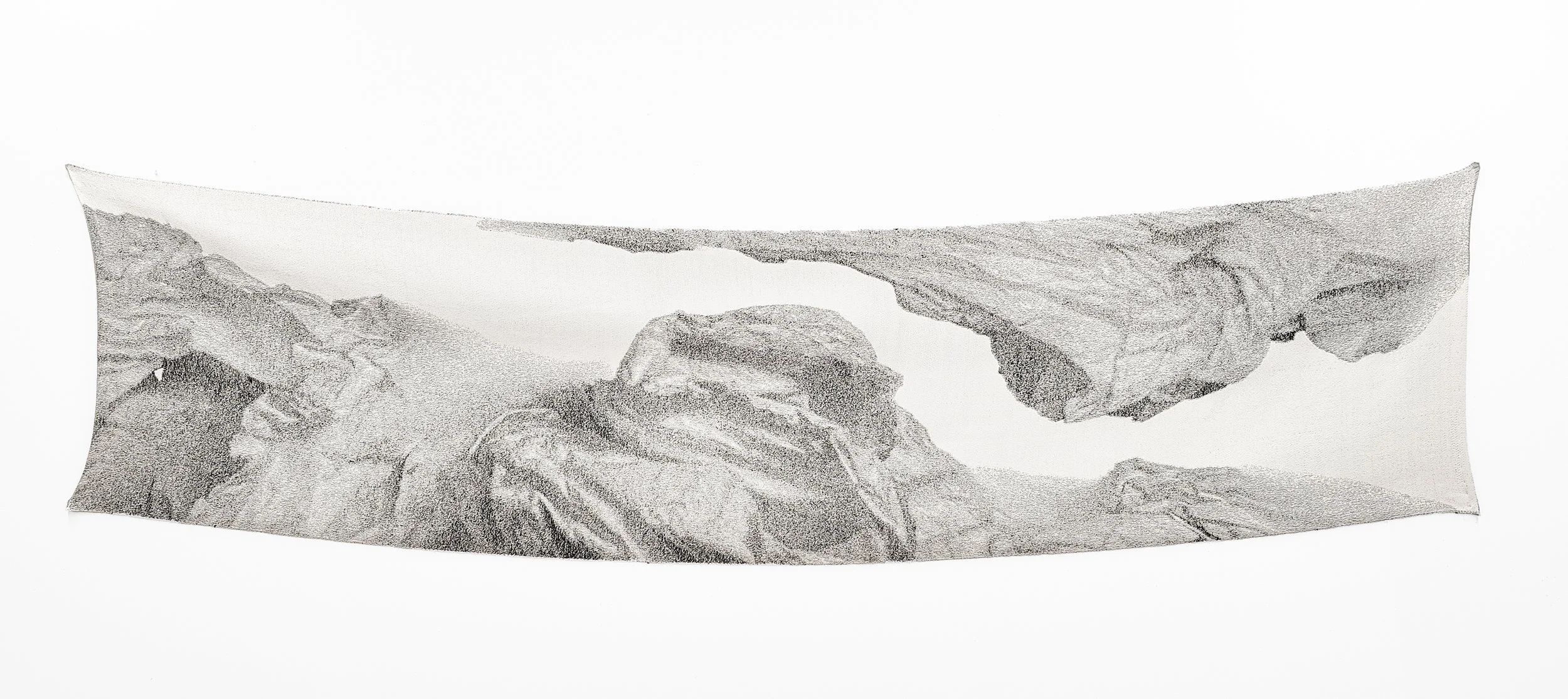
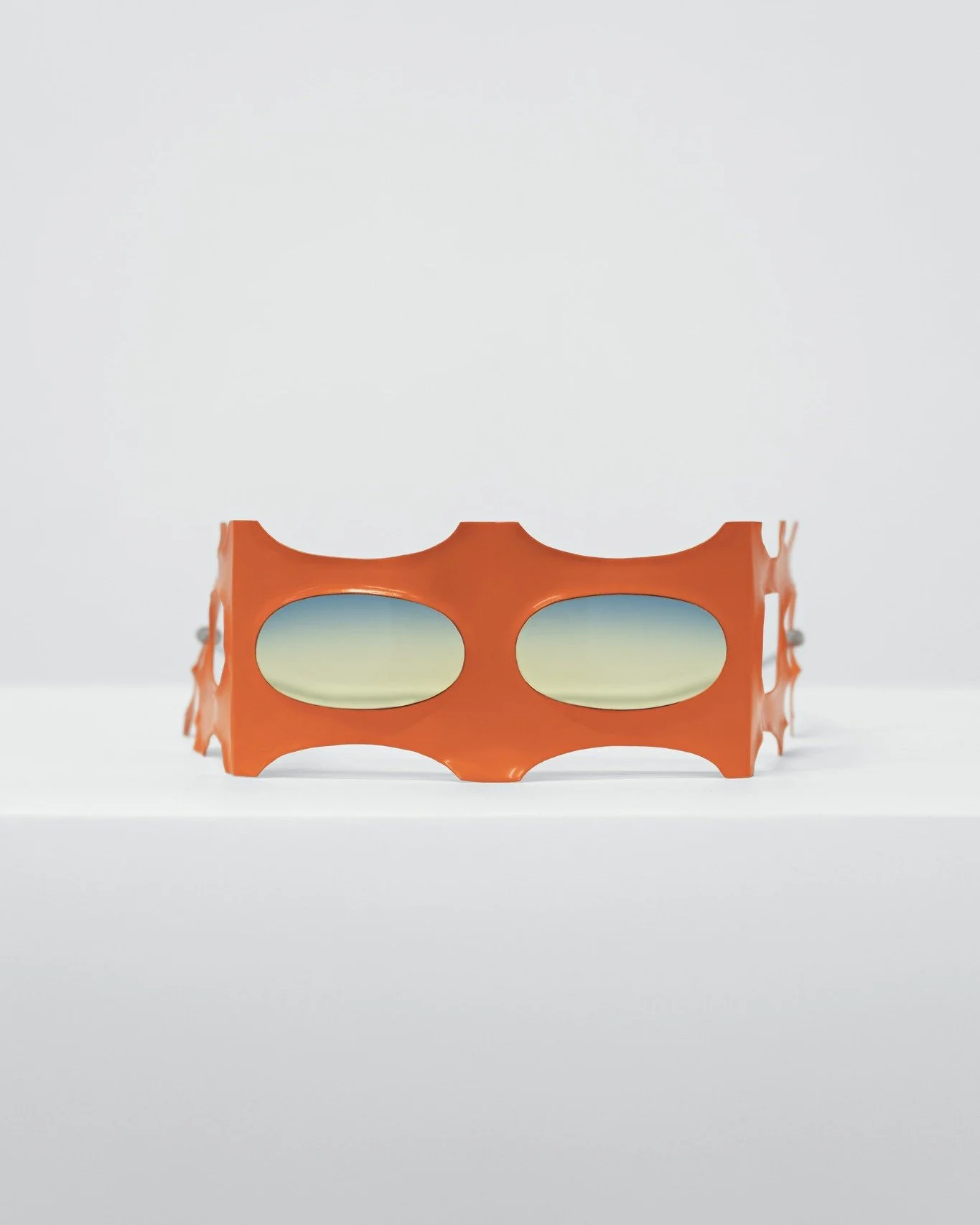
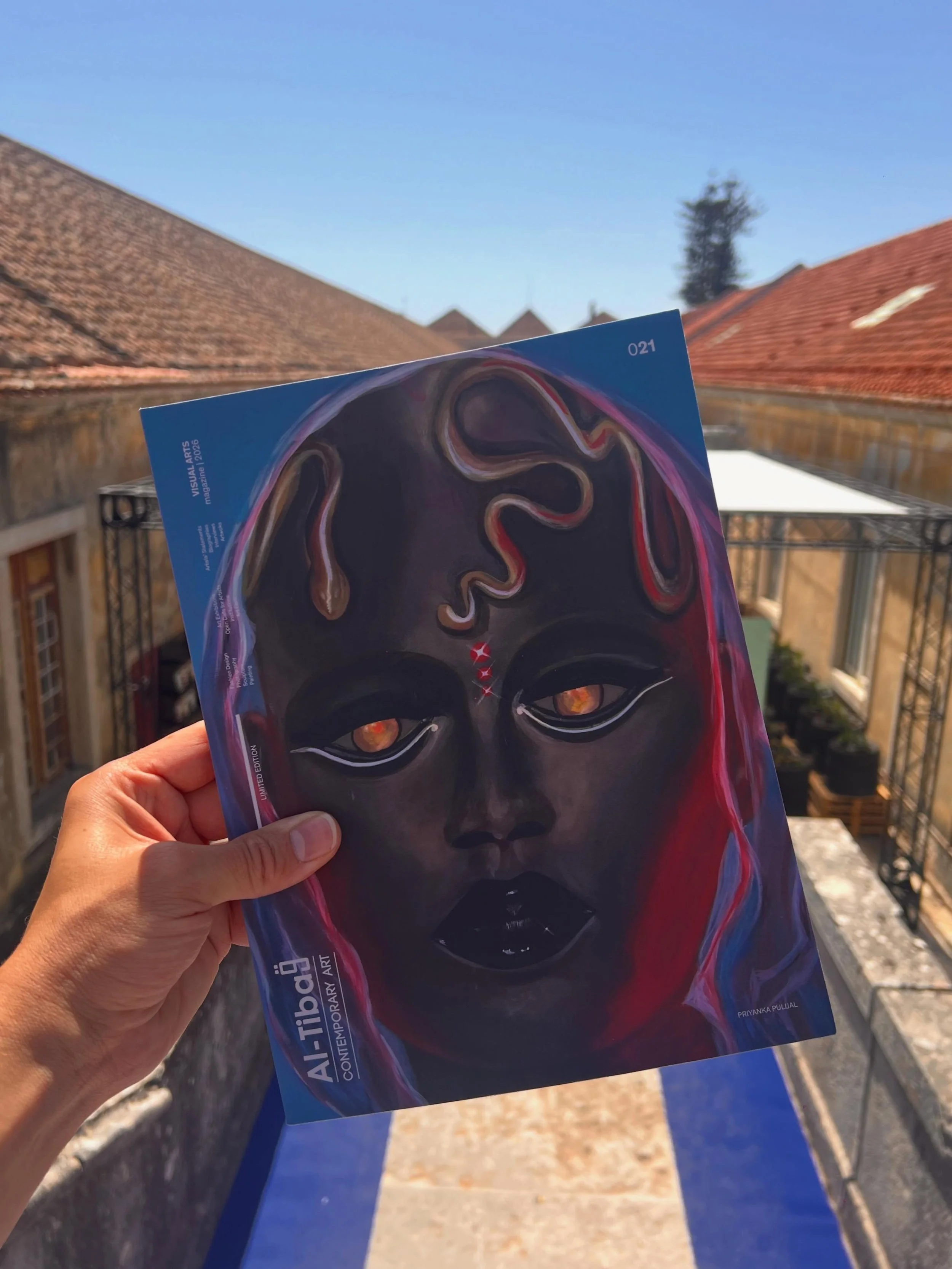
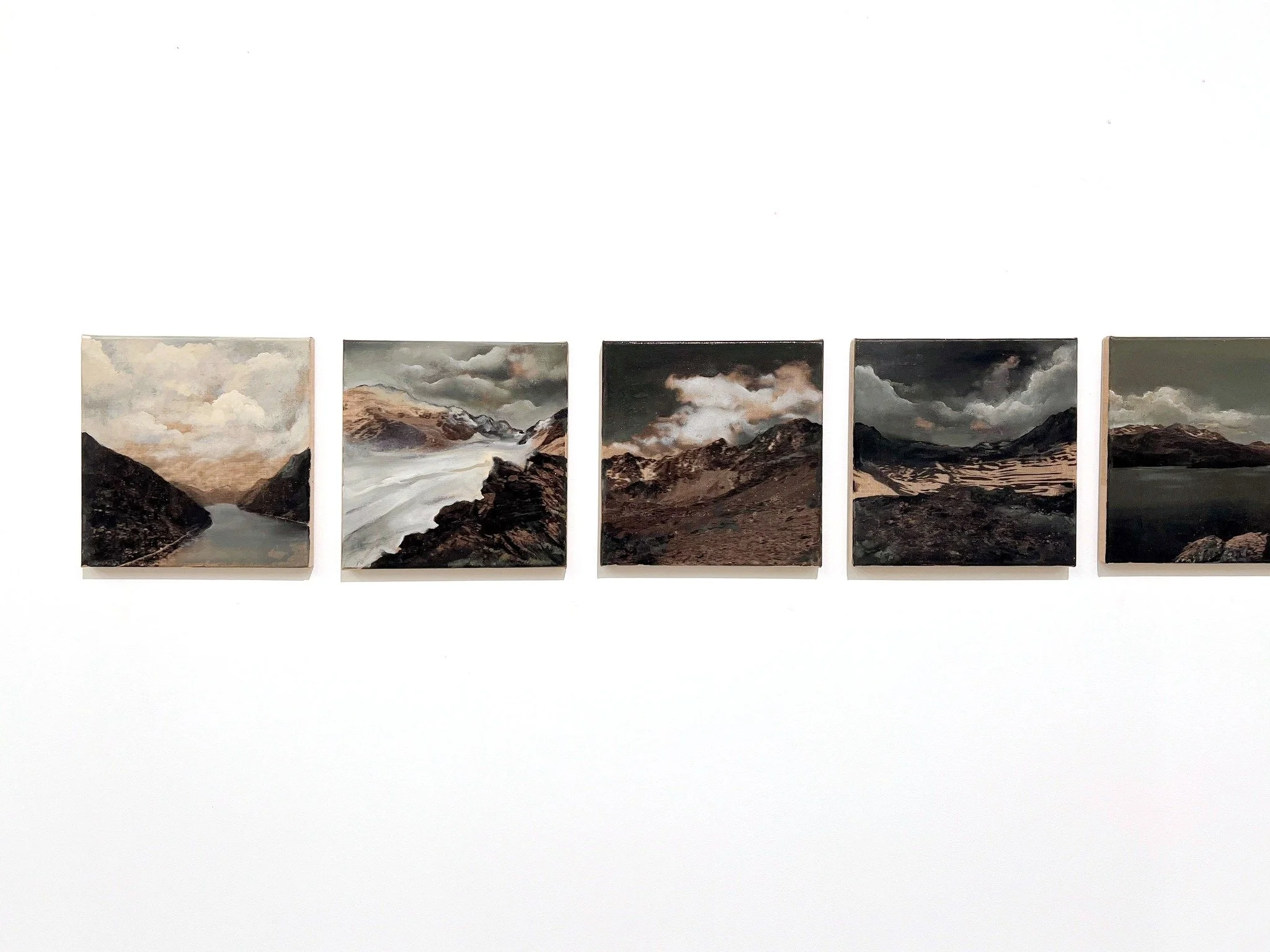
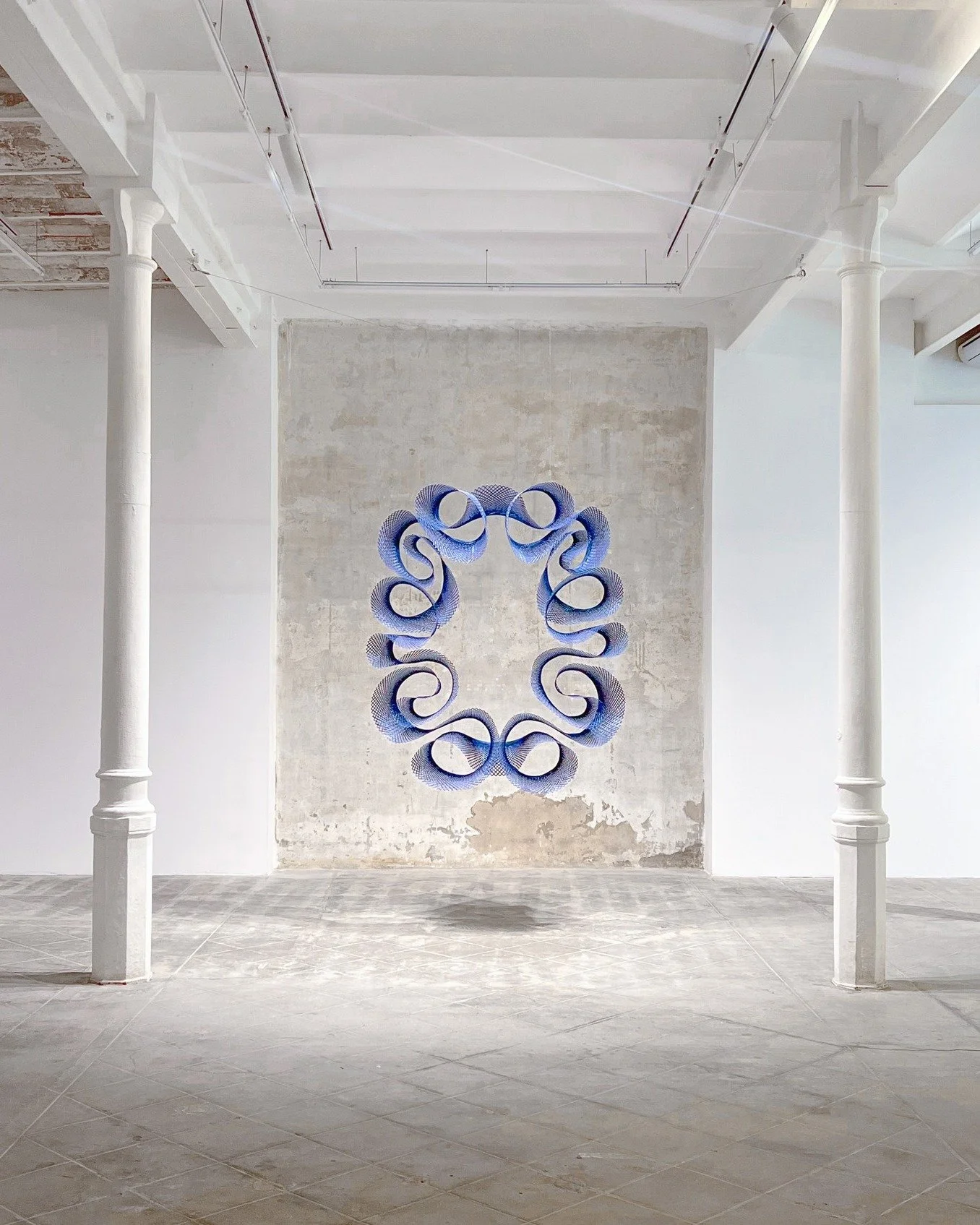
Boris Popoff is a textile artist and designer based in Barcelona. His work merges traditional weaving with sustainable material research. He is the creator of PETEXTILE, a project that transforms post-consumer PET plastic into woven textiles. His practice bridges craft and experimentation, positioning weaving as a cultural heritage and a contemporary investigation. He has exhibited and collaborated across art, design, and material research.