
10 Questions with João Sobreira
João Carlos Gonçalves Sobreira (Leiria, 1984) is a visual artist whose practice interrogates the limits of painting by expanding it into processes of sound, performativity, and phenomenological research. Operating between material gesture and experiential perception, his work addresses notions of authorship, self-erasure, and the role of chance as a generative force. Sobreira holds a BA in Painting from the Faculty of Fine Arts of the University of Lisbon (2013) and two master’s degrees: one in Fine Arts at ESAD.CR (2016) focused on self-representation, and another in Visual Arts Education at FPCEUP (2022). He is currently a PhD candidate in Painting at FBAUL, developing a body of research that explores how sonic structures can inform and disrupt pictorial thinking.
Active since 2009, he has exhibited in solo and group shows at venues such as Lisbon Airport, Banco das Artes Gallery, Arte Graça Gallery, Manuel Artur dos Santos Gallery, Teatro São Carlos, in Portugal; Cerezo Moreno Museum, Luis de Morales Museum, and Ekaterinburg Museum, in Spain and Russia, respectively. His performative projects include live actions that merge improvisation in music and painting. Since 2020, he has taught History of Culture and the Arts at the Escola Artística do Conservatório de Música de Coimbra.
His work proposes the image as an event, an encounter where the artist relinquishes control, allowing the artwork to emerge as something simultaneously unfamiliar and strangely prefigured.

João Sobreira - Portrait
ARTIST STATEMENT
João Carlos Gonçalves Sobreira develops a painting practice grounded in rhythm, gesture, and the body’s perceptual experience of time. He approaches painting as a form of pulsation, a continuity of gestures shaped by inner states, fluctuations of attention, and the physical presence of the performer. For Sobreira, the artwork emerges through a dynamic interplay between intention and chance, where the body negotiates tempo, resistance, and unpredictability.
His research draws on sound and phenomenology to explore how rhythm is lived before it is articulated. Gesture is understood not as a depiction of rhythm but as rhythm unfolding materially on the surface. This process produces a sense of multitemporality: each work contains overlapping durations, the immediacy of the gesture, the lingering of memory, and the evolving experience of the viewer who encounters it.
Sobreira conceives painting as a resonant field rather than a fixed image. The work is activated through perception, inviting a multisensory engagement in which looking operates like listening. Chance, interruption, and repetition become structural elements that open the painting to interpretation, allowing meaning to arise in the interval between the artist’s actions and the spectator’s presence.
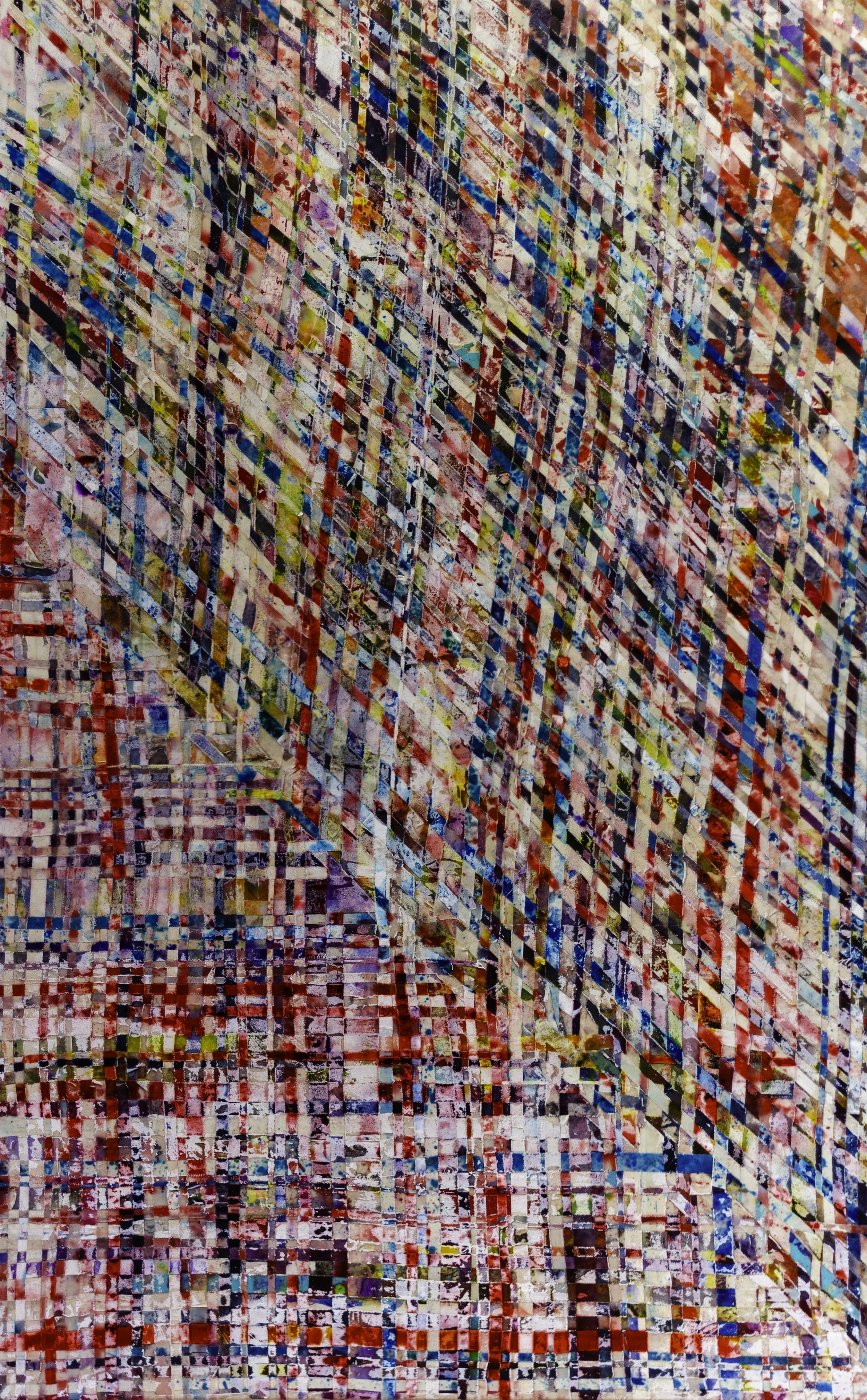
Crossed Rhythm, Mixed Media, 210x130 cm, 2025 © João Sobreira
INTERVIEW
First of all, can you tell us about your background and how you first came to painting as a way of working?
I vividly remember a painting I did at age three in kindergarten, and my mother framing it. The importance given to art that could have been considered childish had a huge impact on me at that moment, and I believe it was the beginning of a very close relationship with painting. Looking back, that moment taught me something I still value today: that painting can carry meaning even before it knows what it wants to say. My family's support was decisive and constant over time, leading me to pursue the arts in secondary school and then a bachelor's and master's degree in painting. I am currently doing a PhD because of this desire to seek ever greater diversity, but, above all, to understand my power of expression.
You describe your practice as expanding painting beyond the canvas. What does painting mean to you today?
For me, painting is a set of relationships between the painter, viewer, time and matter. In this sense, it is a force of expression in the broadest sense of the word, where the canvas contains a set of meanings from the present moment that are captured so that those who experience it later can attribute their own meanings to it. I am not interested in whether the viewer's experience somehow translates the experience I had while painting the picture, but rather that it is something open and with multiple meanings and interpretations. Instead of asking whether the viewer’s experience mirrors mine, I’m interested in how the work continues to live beyond my own gesture. Painting, for me, is an open structure; it doesn’t ask to be decoded correctly, but to be inhabited.
In terms of artistic creation, painting is also a place of time and chance for me. I work with materials in order to incorporate the subjective time of creative flow, the objective time of the material process and the emerging time of chance, which contribute in a certain way to a shared authorship of the work, shared with time, matter, chance and the viewer's experience.
My studio emerges as a place that carries with it temporal dimensions composed of gestures, memories and intentions, in addition to paints and brushes.

4.33” Loop, Mixed Media, 210x130 cm, 2025 © João Sobreira
Rhythm and gesture are central to your work. When did these elements become important in your artistic process?
Rhythm entered my practice when I realised that painting could carry time not only as an image, but as material memory. During my master's degree in Visual Arts, I read Aldous Huxley's ‘The Doors of Perception,’ in which he writes that, under the influence of mescaline, the objects he saw seemed to pulsate or breathe. This idea of objects vibrating or pulsating had a very concrete intellectual effect on me and led me to investigate how this sensation of vibrancy or rhythm, created by the artistic gesture, could be translated or approximated in painting. At that time, I produced some works based on these initial ideas and have been developing this concept ever since. These works consisted of painting one side of the canvas and exposing the reverse side, allowing the material to have a kind of free will over what would pass through to the exposed side. It was also here that I began to explore more deeply the concepts of temporality and chance, both because of the time it took for the paint to pass through to the reverse side of the canvas and because of the surprise of the work I discovered when I turned the canvas over. In this process of exploration, many canvases were stored away and never exhibited because they lacked sufficient strength and were systematically saved from the rubbish. During my PhD, I had the idea of combining music with painting, and the concept of rhythm returned, intertwined with that of temporality. The stored canvases were torn into pieces and interwoven, in a systematic exploration of the concept of visual rhythm intertwined with multiple layers of temporality: the time of the canvases, the time of the interweaving, and the time of the resulting rhythm. When I interweave those fragments, I’m not recycling materials; I’m reactivating time.
Sound and music strongly influence your practice. How does music shape the way you paint or perform?
I have always felt an exaggerated sensitivity to repeated and high-pitched sounds. It is clear that the sounds of the moment influence our mental state and, consequently, our artistic practice. The surrounding environment includes the music playing in the workspace, the sound of brushstrokes or spatulas, and even the sound of our thoughts as we paint. The music I listen to isn’t a soundtrack but a variable, something that shifts my attention, alters tempo, and interferes with decision-making. In my workspace, I oscillate between music and silence, ranging from Deftones to classical, depending on my mood. Just as the material alters the work produced, music and silence also intervene as factors of chance in artistic production, playing in the same field as the bodily gesture that produces the object.
In the case of live performances, the performers' music directly influences the work, both in the choice of colours and in the gestures that translate into shapes, lines or marks in response to the rhythms, harmonies and melodies perceived. This influence can be convergent with what is heard, or deliberately dissonant with it. Sound doesn’t illustrate my work; it destabilises it.

nº1, Mixed Media (verse), 160x99 cm, 2023 © João Sobreira

nº13, Mixed Media (verse), 160x99 cm, 2024 © João Sobreira
In your work, chance plays an active role. How do you balance control and unpredictability while working?
Control involves project planning, the initial idea that emerges and serves as the architecture of the work. Once this plan is in place, with a series of rules that cannot be broken from the outset, unpredictability arises in the behaviour of the material, on the one hand, and on the other, in the micro-decisions that can be made that take the plan in a different direction, close, but often further away from what was initially planned. In addition, there is an untamed artistic instinct that sometimes completely overrides the initial plan. The more dissonant from the initial thought, the more the works appear to be closer to a kind of unconscious inner world that surfaces. I don’t oppose control and chance; I design situations where they negotiate.
You often work through live actions that combine music and painting. What do these performative moments allow that studio work does not?
First and foremost, communication with other humans. My pictorial practice is markedly solitary and individualistic, despite having indirect interactions with a myriad of ideas, concepts and people. These performative moments allow me to step outside my comfort zone, in the sense of communicating directly with other artists and with the public, where the artist appears as a performer and an individual rather than as a finished work of art to be observed in a museum or gallery. Furthermore, real-time communication in the form of art is a laboratory of gestures and practices that have very specific characteristics and challenges, especially in terms of time, but also in interaction with the sound communicated, which, depending on the mood of the moment, can result in a work that is consonant or dissonant with what is heard. These performances also inform how the works later exist as autonomous objects.

nº4, Mixed Media (verse), 160x99 cm, 2023 © João Sobreira
Your research engages with phenomenology and perception. How do you want viewers to experience your work physically or emotionally?
The experience of perception as described by Merleau-Ponty indicates a relationship experienced by the body of the observer, in constant dialogue with the space and objects that surround it. Thus, if the work of art influences the observer, the observer influences, through their perception, the way in which the work of art is retained in their memory. I intend for my works to be experienced both physically, through the perception and experience of rhythm in the body and mind of the observer, and emotionally, through each individual's perception of the artistic object. Some of the works that I present here explore the concept of rhythm as an operative tool in pictorial creation, and I seek to trigger a physical sensation of vibration and pulsation, as described by Huxley in ‘The Doors of Perception,’ but also perhaps the recollection of a piece of music associated with a memory. I want the viewer to feel the rhythm before understanding it.
Teaching is also part of your practice. Does working with students influence how you think about art-making?
The subject I teach, art history, both general and specific to dance and music, has brought me closer to two artistic areas that are distinct from my own and has prompted a reflection that sparked the idea of a crossover between music and visual art. The fact that my students are, in most cases, future performers makes me feel that it is also important for them to understand the importance of one art form in another and not to focus excessively on their own. Coming into contact with different areas also influences my thinking about my own art.

Palimpsest of the Studio, Mixed Media, 160x99 cm, 2025 © João Sobreira
What artists, musicians, or thinkers have been key influences on your work over the years?
Rothko and Pollock were the central focus of my master's degree and remain rooted in my subconscious to this day, mainly due to the expressive power of their gestures, in Pollock's case, and the impact of seeing the works in person, in Rothko's case. More recently, I have been influenced by the thinking and work of Kandinsky, Kupka and the Delaunays, for their clear influence on the connection between music and painting. For no particular reason, and out of pure admiration for their artistic work, Kiefer, Anish Kapoor and Richter. In the field of music, Chino Moreno is on one side of the spectrum, and Beethoven is on the other. Lately, I have also been exploring minimalist and conceptual music. In the field of philosophy, Merleau-Ponty, for his connection with the body in the phenomenon of perception, Mihaly Csikszentmihalyi, for his notion of flow, and Huxley, a diverse thinker who is absolutely relevant today.
And lastly, what projects or research directions are you currently developing, and what can we expect next from your practice?
I am currently expanding the concepts linked to the series of works connected to rhythm, which involve, besides rhythm, temporality and weaving, to larger-scale works. I am also involved in several live performance painting projects, in connection with other arts, not only music but also dance. In relation to my research, I plan to explore several directions shortly regarding the concepts of synesthesia. What interests me now is testing how far these ideas can go, in scale, in collaboration, and in how painting can remain a temporal experience even when it becomes monumental.
Artist’s Talk
Al-Tiba9 Interviews is a promotional platform for artists to articulate their vision and engage them with our diverse readership through a published art dialogue. The artists are interviewed by Mohamed Benhadj, the founder & curator of Al-Tiba9, to highlight their artistic careers and introduce them to the international contemporary art scene across our vast network of museums, galleries, art professionals, art dealers, collectors, and art lovers across the globe.




Yuhan Gu is a New York–based industrial designer whose work explores the intersection of function, emotion, and sculptural form. TACTO reflects Gu’s interest in the emotional relationship between people and the objects they keep close in their daily workspace. Designed as a cactus-shaped memo holder, the project transforms a familiar natural form into a playful and functional desktop object.