

10 Questions with James Van Ipo
JAMES VAN IPO is an Austrian artist whose practice connects digital image development with physical materiality. Rooted in a technologically informed aesthetic, his works move between portraiture, abstraction, and object. Developed in a cohesive series, his practice is shaped by algorithmic visual language, fragmentation, and relief. Through the use of mixed media, acrylic, epoxy resin, and industrial materials, he translates virtual image worlds into tangible, embodied surfaces. His work explores the tension between code and reality, construction and presence, and examines how identity becomes visible in the age of digital images.
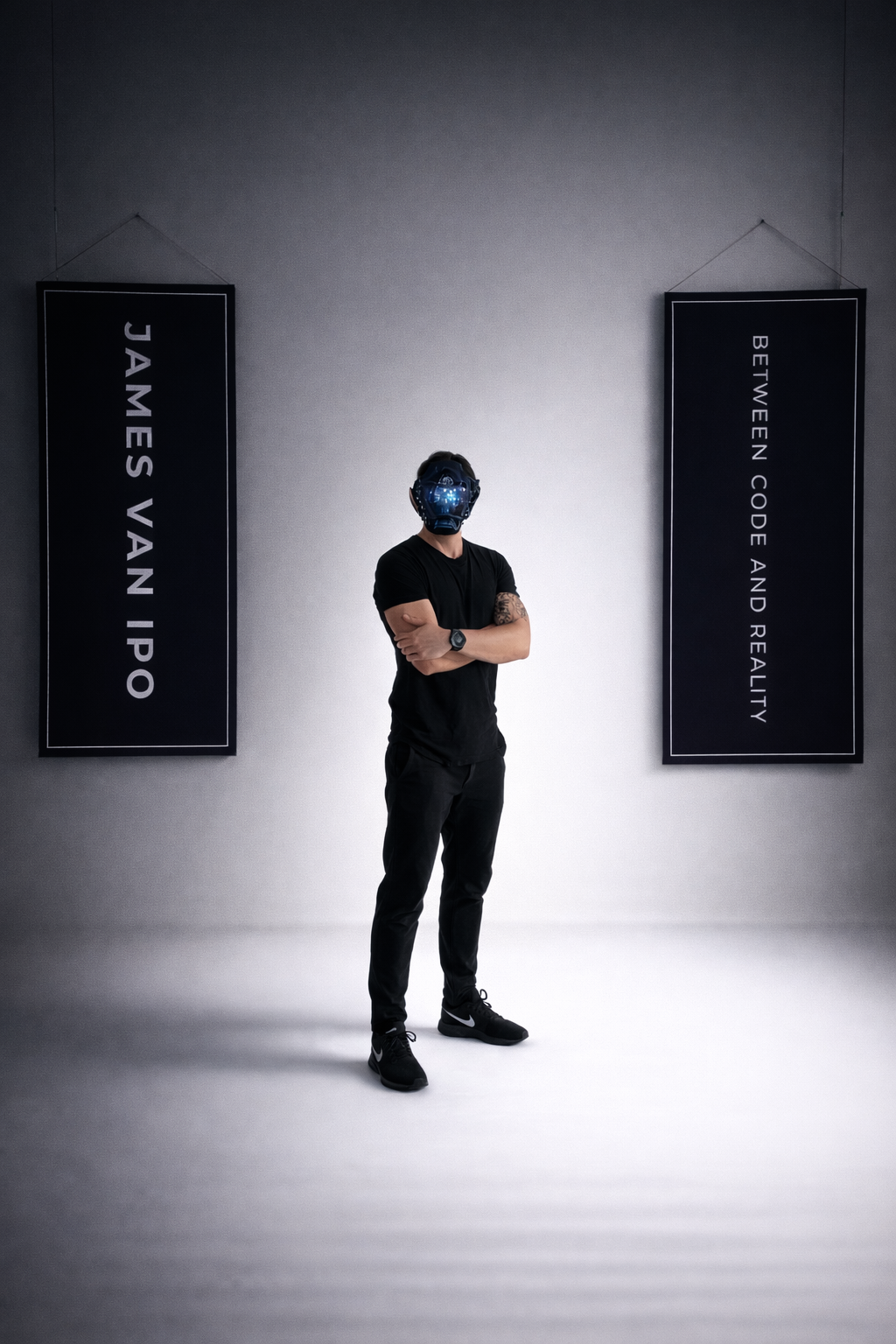
James Van Ipo - Portrait
ARTIST STATEMENT
JAMES VAN IPO’s practice examines the transformation of digital imagery into physical experience. Working across portraiture, abstraction, and object-based forms, he explores fragmentation, perception, and the unstable construction of identity in contemporary image culture. His works are developed in cycles of fifteen pieces, combining nine portraits and six abstract works that form an interconnected body of work. Through layered mixed-media processes, algorithmic aesthetics are translated into tactile surfaces where relief, disruption, and material presence play a central role. The works are conceived not as flat images, but as hybrid image-objects in which surface, depth, and structure become inseparable. Situated between code and reality, his work reflects on how technological systems shape the way images are produced, embodied, and understood.
Between Code And Reality #8-01000001, Mixed Media On Panel, 100x75 cm, 2026 © James Van Ipo
INTERVIEW
First of all, can you tell us about your background and how you first became interested in art?
My interest in art began around eight years ago, when I visited an exhibition opening for the first time. That evening, I also bought works by artist friends of mine, and they had a strong impact on me. It made me realize how deeply art fascinated me, even though I was not yet making work myself at that point.
Only afterwards did I begin creating my own images with acrylic. Quite quickly, however, I realized that a purely flat surface was not enough for me. I wanted more structure, more depth, and something that felt physically tangible. From the beginning, I was drawn to works that not only function visually, but also through their material presence.
That eventually led me to working with concrete and epoxy resin, which I explored intensively over several years. This phase was important for me because it was when I began to understand the image not only as a surface, but as an object.
Later, my background in IT and the startup world brought a digital dimension into my practice. Since I had already been working with Photoshop and other programs for a long time, I began developing digital visual worlds and combining different layers and processes. My current artistic practice grew out of this connection between digital development and physical realization.
What led you to explore the relationship between digital images and physical materials?
What interests me is precisely this transition from the virtual into the physical. A digital image first exists only on the screen, and even there, it can already suggest gloss, depth, or tension on the surface. But for me, it only becomes truly exciting when I bring that image into reality and continue working on it by hand.
Through physical materials, the image changes once again in a very clear way. It gains more presence and affects the space differently than it ever could in a purely digital form. That moment is what fascinates me, because a purely virtual image begins to exist as something that can also hold its own in real space.

#1-01000001 © James Van Ipo
You work with both portraiture and abstraction. How do you decide which direction to take?
For me, it is less a decision between portraiture and abstraction than a connected process. Many works begin in a highly abstract way and develop out of digital structures or free image fragments. Only over time do I shape those elements into a female portrait.
That is why both directions are directly connected in my work. Within my series, abstract works and portraits always exist side by side. I do not see one as the opposite of the other, but rather as two states within the same system. Abstraction is often the starting point, and the portrait is the more condensed form.
Why do you develop your work in a structured series of fifteen pieces?
The number fifteen is not arbitrary for me; it is a recurring part of my system. Each cycle consists of fifteen works. Often, that means nine female portraits and six abstract pieces, although there can be shifts within that structure. What matters to me is not a rigid distribution, but that the overall framework remains intact.
The number itself is derived from two numbers that are closely connected for me: nine and six. Nine has long been my lucky number, and when turned upside down, it becomes six. Together they form fifteen. Over time, this developed into a fixed system that carries my cycles.
In addition, each cycle is titled through a binary code. If you decode it, you can read the name of the respective cycle. In this way, the visual level of the work is connected to another conceptual layer.
Your materials include acrylic, resin, and industrial elements. What draws you to these specific choices?
I am drawn to acrylic because it allows a great deal of freedom and experimentation. It is a material that opens up many possibilities and, at the same time, works very well in combination with epoxy resin. That combination is essential to my practice.
Epoxy resin is central to me because it allows me to build relief-like and glossy layers. I am especially fascinated by the moment when light, or even the surrounding space, is reflected in the surface of a work. That changes the image depending on the viewing angle and movement, and it starts to function differently within the space.
I chose industrial elements consciously because, for me, they connect very well with the digital world. They bring something technical, precise, and also raw into the work. Overall, my material choices were never based on a finished plan from the beginning. They are the result of a great deal of experimentation until I found the exact combination that fits my visual language.

#3-01000001 © James Van Ipo

#6-01000001 © James Van Ipo
How does your creative process usually begin? With an image, a concept, or a material?
My process almost always begins digitally. At the beginning, there is an image that I continue developing until a concept gradually emerges from it. This usually does not happen through a single work, but through several images developing at the same time.
I work in cycles. That means I develop different drafts in parallel until a clear direction begins to appear. At a certain point, something clicks, and I know that this is where the next series will come from.
The material comes later. Once the digital concept is in place, I begin to think about how to translate it physically onto the image and which materials are right for it. So for me, the starting point is almost always within software, and the material realization follows afterwards.
You often refer to algorithmic aesthetics. How do digital tools influence your work?
Digital tools influence my work very strongly because they are not just technical instruments for me, but an essential part of the process itself. I never work with only one tool. Depending on the cycle, I usually work with five to ten different programs, and each of them contributes something different to the development of an image.
What matters to me is selecting very precisely from those possibilities. I do not use many tools at once just for the sake of it, but only the ones that I need in order to develop a specific image digitally. In that way, my visual language emerges step by step through different software-based processes.
I am especially interested in p5.js because it allows me to intervene directly in the image through code. In this way, the algorithm does not remain only an idea in the background, but becomes a visible part of the work itself.
The fact that digital tools are so central to my practice also has to do with my own background. I grew up in the digital age, and I have always been fascinated by what can be developed and shaped through software. That is why this digital influence feels very natural in my work.

#2-01000001 © James Van Ipo
Your works have a strong sense of texture and relief. How important is physical depth in your practice?
Physical depth is very important to my work because it is an essential part of my visual language. Through relief, texture, and material, I bring something that originally emerged digitally into the real world. That is exactly where it becomes interesting for me.
A digital image can already have a strong impact, but for me it only truly comes alive when I continue working on it by hand and give it material depth. It is only in this connection between digital aesthetics and physical realization that my own signature becomes fully visible. That is what matters most to me.
You explore identity in the digital age. What questions are you trying to raise through your work?
I am interested in how identity is formed through images today, and how strongly it is already shaped by digital surfaces. Especially in my portraits, I am not trying to depict one specific person, but rather a field of tension between presence, projection, and construction.
I ask myself what we actually still recognize in a face today. Are we seeing a real person, a staged image, or something already shaped by digital aesthetics? That ambiguity interests me because identity in the digital age often no longer appears fixed or fully clear, but moves between surface, fragment, and perception.
When I transfer a digitally developed image into physical reality, that question changes again. Through material, relief, and depth, the image gains another kind of presence, while at the same time remaining open and not entirely resolvable. That is exactly the tension I want to make visible in my work.

Between Code And Reality #4-01000001, Mixed Media On Panel, 100x75 cm, 2026 © James Van Ipo
What are you currently working on, and how do you see your practice evolving in the future?
At the moment, I am still working on the final pieces of my first cycle, which I will present on 5.06.26 in my first larger exhibition in Mondsee. At the same time, the next concept is already in development.
This upcoming cycle will again be based on my system of fifteen works, but it will evolve in an important way: light will take on a new role within it. Until now, light has entered my work mainly through reflection, gloss, and the way the work is lit within the space. In the next step, I want to integrate light directly into the image and make it controllable in a more precise way.
What interests me here is not a simple effect, but a precise conceptual extension of my practice. The digital prototype has already been developed, and the physical development will be the next step.
I see my practice as something continuously evolving. In my future works, the connection between digital conception, physical materiality, and light will come together even more strongly.
Artist’s Talk
Al-Tiba9 Interviews is a promotional platform for artists to articulate their vision and engage them with our diverse readership through a published art dialogue. The artists are interviewed by Mohamed Benhadj, the founder & curator of Al-Tiba9, to highlight their artistic careers and introduce them to the international contemporary art scene across our vast network of museums, galleries, art professionals, art dealers, collectors, and art lovers across the globe.





Yuhan Gu is a New York–based industrial designer whose work explores the intersection of function, emotion, and sculptural form. TACTO reflects Gu’s interest in the emotional relationship between people and the objects they keep close in their daily workspace. Designed as a cactus-shaped memo holder, the project transforms a familiar natural form into a playful and functional desktop object.