

10 Questions with Francesca de Marco on artist Yuri
Yuri (Paolo Ornelli) was born in Magliano Sabina (Rieti) on January 8, 1958, and moved in his youth to Castel Sant’Elia, a small town of about 2,000 inhabitants in the province of Viterbo, in the countryside north of Rome. Self-taught, he works as a blacksmith and stonemason.
He contributed to the restoration of the entrance bridge of the Rocca di Nepi, realized by Antonio Sangallo in the 15th century; he created the balustrade columns of the staircase at Villa Torlonia in Frascati; and he collaborated with the British sculptor Simon Verity on his Sundial sculpture now exhibited in the Bass Garden at the American Academy in Rome. A statue from Yuri’s Masai Group has become part of the stylist Ilaria Venturini Fendi’s private collection.
Yuri has always lived and still resides alone in his tufa quarry, together with his faithful mare and surrounded by his works.
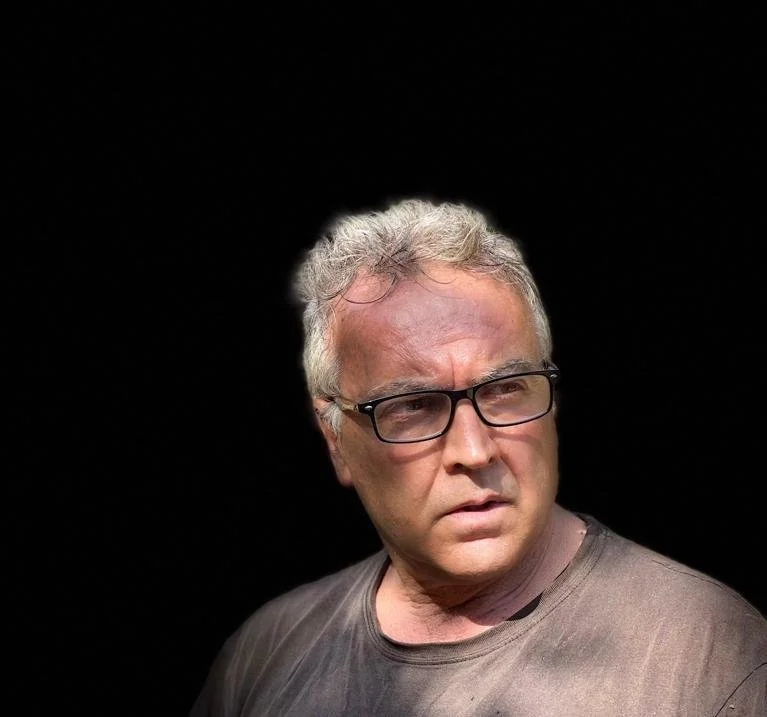
Yuri - Portrait
ARTIST STATEMENT
Yuri (Paolo Ornelli) lives in a tuff cavern in near-complete solitude, accompanied only by a mare and by the breathing of the seasons. Here, Yuri has shaped his personal aesthetics of resistance and impermanence: tuff that crumbles, iron that softens, shrubs that reclaim the places where he works. His works are fragments of the wall that encloses him, pulled out, carved out, wrested from his own shelter. A double gesture, a literal grasping: to seize and to hollow, to hold and to release.
A slow maieutics of matter, whose destiny is entrusted to time and to the elements. Once freed, his sculptures remain scattered around him like inhabitants of a silent, enchanted realm, beaten by wind and rain, mute companions to his solitude. They are objects that long for mortality, born from the quarry only to become alive, weathered by gusts of air, steeped in water. His works do not pursue perfection, but material truth. His anti-aesthetic challenge invites each object in a generative dialogue between time and landscape, as a reminder of existence’s ceaseless flow. Thus, The Guardian of the Swamp, resting by the water’s edge, becomes inhabited by humidity, shifting in color, slowly covering itself in moss. The long stone body of Adolescent, surrendered to the elements, grows yellow and old, dramatizing the contrast between its gesture of modesty and its mischievously sticking its tongue out.
Tuff is the heart of his language, a stone that for him “is fragile and hard at once, alive, different each day.” Yuri does not plan, does not sketch, does not follow academic patterns. He carves what appears on the walls of his dwelling, as though the forms were already sleeping within them, waiting to be released. Every surface is a revelation, every fracture a direction. Time, rain, filtered light, passing animals - everything becomes part of the process. The material is both teacher and accomplice.
Alongside tuff, Yuri works with iron salvaged from abandoned machines. He bends it, welds it, follows its pliancy. If stone lets him uncover hidden forms, iron offers the opposite: “to fill the void with metal lines and the remnants of machines,” to build new anatomies, to anchor memories. Thus, The Shaman, a stove-object, magically comes alive in the act of swallowing firewood, blackening, and rusting.
Yuri’s work inhabits a threshold, between excavation and construction, between ruin and renewal. Through stone and iron, he shapes an unspoken philosophy: that every material carries a past, compressed time, and a possible future. In his world, making is inseparable from living, and art rises directly from the earth, giving voice to the unspeakable solitude of creation.
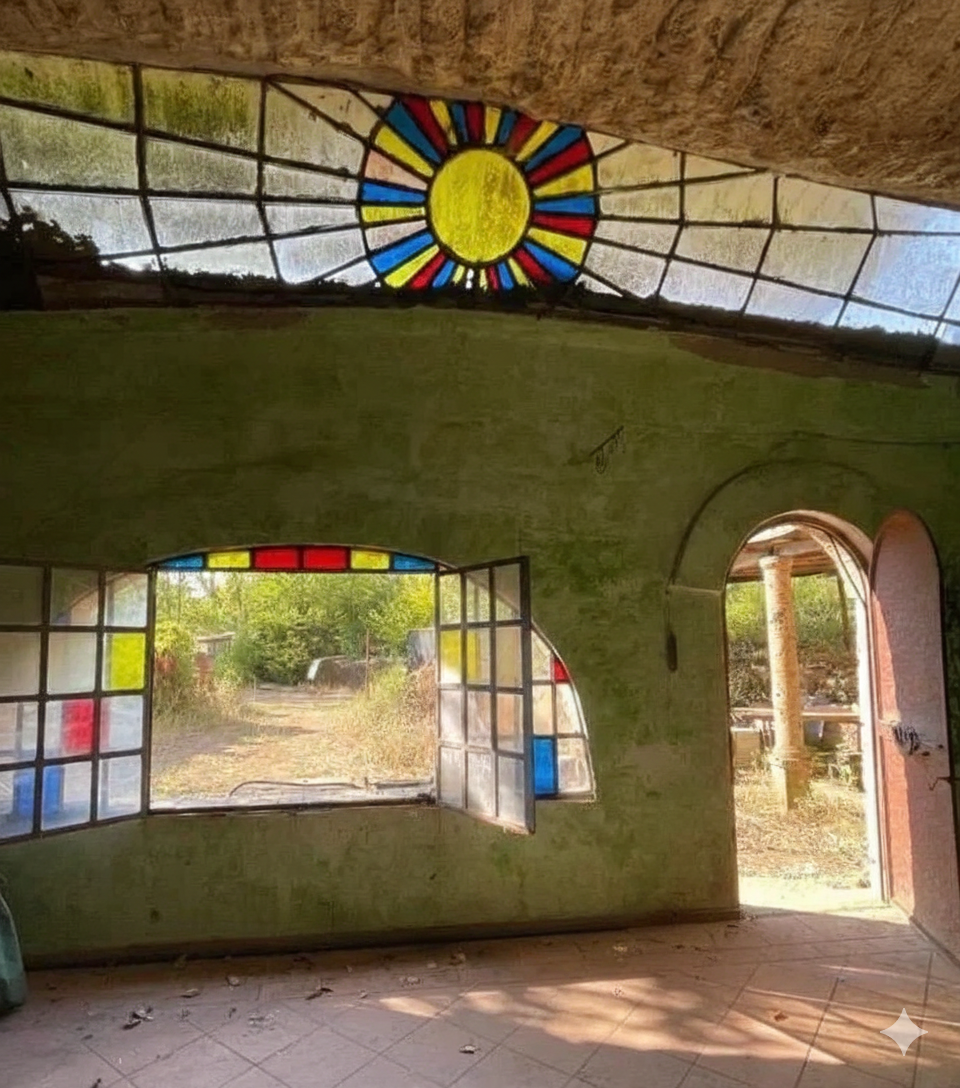
Good Vibes, recycled coloured glass, iron, 300x50 cm, 2010 © Yuri
INTERVIEW
First of all, how would you describe Yuri’s background and his path to becoming an artist?
Yuri, born Paolo Ornelli in 1958, grew up in the Tuscia region, north of Rome, a land deeply marked by Etruscan remains, volcanic stone, and a sense of buried time. His path to becoming an artist did not follow institutional or academic routes. Self-taught, he learned by working as a stonemason and blacksmith, developing an intimate knowledge of materials through restoration projects and manual labor. Over time, art emerged organically from this relationship with matter and place, becoming inseparable from his decision to live and work alone in a former tuff quarry near Castel Sant’Elia.
How and when did you first discover Yuri’s work, and what struck you immediately?
It was a real serendipity. A couple of years ago, I was wandering around in the Tuscian landscape, and I accidentally found a locked iron gate, whose suspended decorations made me think of Calder. I managed to enter and found myself in an enchanted place full of artworks, abandoned, covered by plants, as in a secret magic garden. I saw a tuff column trapped in a delicate iron cage, a severe head of tuff covered with moss. Walking around, other sculptures appeared, scattered among the tall grass.
It took me a while before realizing that I was inside a tuff quarry and that someone lived there and produced the sculptures spread all around in the bush. His works didn’t seem to seek visibility; they revealed themselves quietly: raw, poetic, and resistant. It was a real shock.
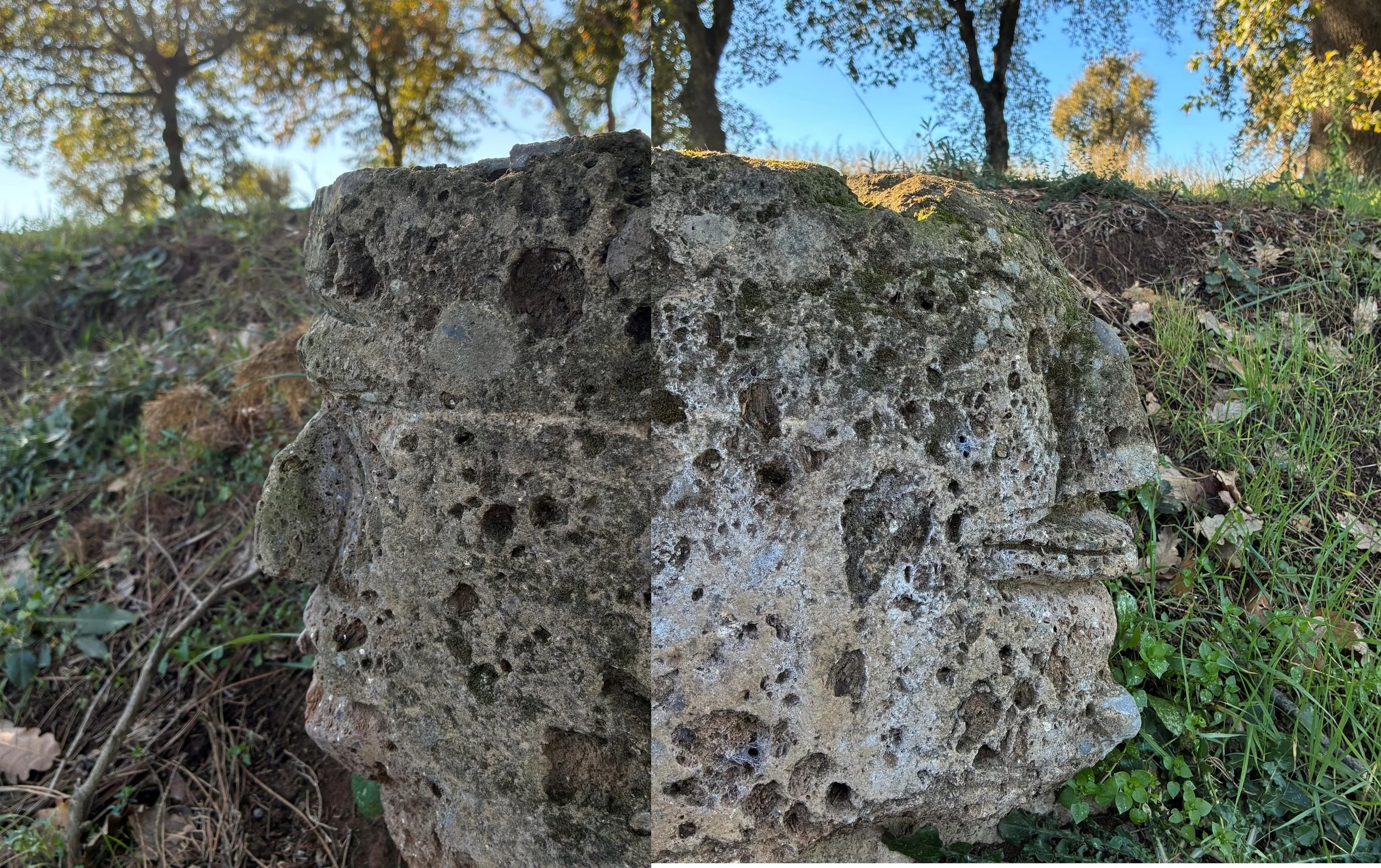
Janus, basement of a cypress, volcanic stone, 100x48x100 cm, 2023 © Yuri
Yuri is self-taught and works as a blacksmith and stonemason. How do these skills shape his artistic practice?
Yuri’s practice is entirely shaped by embodied knowledge. As a stonemason, he learned to read tuff, its fractures, porosity, and hidden weaknesses. As a blacksmith, he learned how iron yields, bends, rusts, and remembers. These skills shape a practice based on listening to materials rather than dominating them. His sculptures emerge from gestures refined through years of physical engagement, where craft and intuition merge seamlessly.
Why do you think stone, especially tuff, became such a central material in his sculpture?
Tuff is the substance of Tuscia and the substance of Yuri’s life. Formed from volcanic ash, it is both tough and fragile, capable of holding form while constantly eroding. Living inside a tuff quarry, Yuri encounters stone as a daily presence rather than a resource. He literally grabs the stone directly from the walls of his home, releasing forms that seem to have been sleeping within the rock. Despite his living in the tuff since ever, and having no conscious knowledge of Tuscia’s medieval past, his works resemble medieval sculptures. And like Civita di Bagnoregio, the Tuscian “dying town” perched on crumbling tuff, his sculptures embody a beauty exposed to time and loss.
What role does iron play in his work, and how does it complement the use of stone?
Iron introduces another temporal layer. Often salvaged from abandoned machines, it carries traces of industrial life and forgotten labor. While stone allows Yuri to hollow, extract, and reveal, iron enables him to connect, anchor, and fill voids with linear gestures. In his artworks, iron becomes almost anatomical, aging alongside stone through rust, heat, and exposure, reinforcing the idea of sculpture as a living organism.

Kyrba the Hero, volcanic stone, 35x20x15 cm, 2023 © Yuri

Unicorn, volcanic stone, 30x20x10 cm, 2025 © Yuri
Swan Born Steed, volcanic stone, 28x28x10 cm, 2024 © Yuri

The Oracle, volcanic stone, 50x40x20 cm, 2020 © Yuri
How would you describe Yuri’s creative process, from the moment he encounters the material to the finished work?
It is rather difficult to talk to Yuri and to make him describe the steps of his creative process. Surely Yuri does not sketch or plan. His process begins with observation- of a wall, a fracture, a change in light. Every surface suggests a possibility, every break a direction. Time, rain, humidity, animals, and plants all participate in shaping the work. Once freed from the quarry, the sculpture is not completed but released, entrusted to the elements. His process is a slow, continuous negotiation between intention and surrender.
What are the main themes or ideas that you see emerging consistently in his sculptures?
Impermanence, resistance, solitude, and coexistence with nature. Yuri’s sculptures reject polish and permanence in favor of material truth. They exist on a threshold, between ruin and creation, excavation and dream. His work speaks of mortality without drama, embracing decay as a form of life rather than an end.

Adolescent, volcanic stone, 250x16x35 cm, 2018 © Yuri
Yuri lives and works in near-complete solitude in a tuff quarry. How does this way of life influence his work and worldview?
Solitude is Yuri’s chosen condition and creative engine. Living almost entirely alone, occasionally riding his motorbike into town for a solitary glass of red wine, he maintains a minimal connection to society while remaining deeply rooted in the landscape. His home, wholly carved within the quarry- furnished with reclaimed objects, colored glass windows, and mirrored fragments - has become a living sculpture. This way of life sharpens his sensitivity to time, erosion, and subtle transformation, which permeate his work.
What strategies are you considering to make Yuri’s work more visible and recognizable to a wider public? Are there any upcoming projects, collaborations, or exhibitions planned that will further develop your relationship with Yuri and his practice?
Being not a professional art curator and simply dealing with art collection out of love for artistry, I find it difficult to imagine the proper tools to promote his works. Still, I think that a possible agent-to-come should be highly respectful of the integrity of Yuri’s practice and its bond with place. Visibility should probably be approached as a form of translation rather than exposure, allowing audiences to sense the quarry, the land of Tuscia, and the unconventional philosophy that shapes his work. In addition to that, any strategy addressed would probably need to comply with Yuri’s ultimate desire for solitude and silence.
Artist’s Talk
Al-Tiba9 Interviews is a promotional platform for artists to articulate their vision and engage them with our diverse readership through a published art dialogue. The artists are interviewed by Mohamed Benhadj, the founder & curator of Al-Tiba9, to highlight their artistic careers and introduce them to the international contemporary art scene across our vast network of museums, galleries, art professionals, art dealers, collectors, and art lovers across the globe.


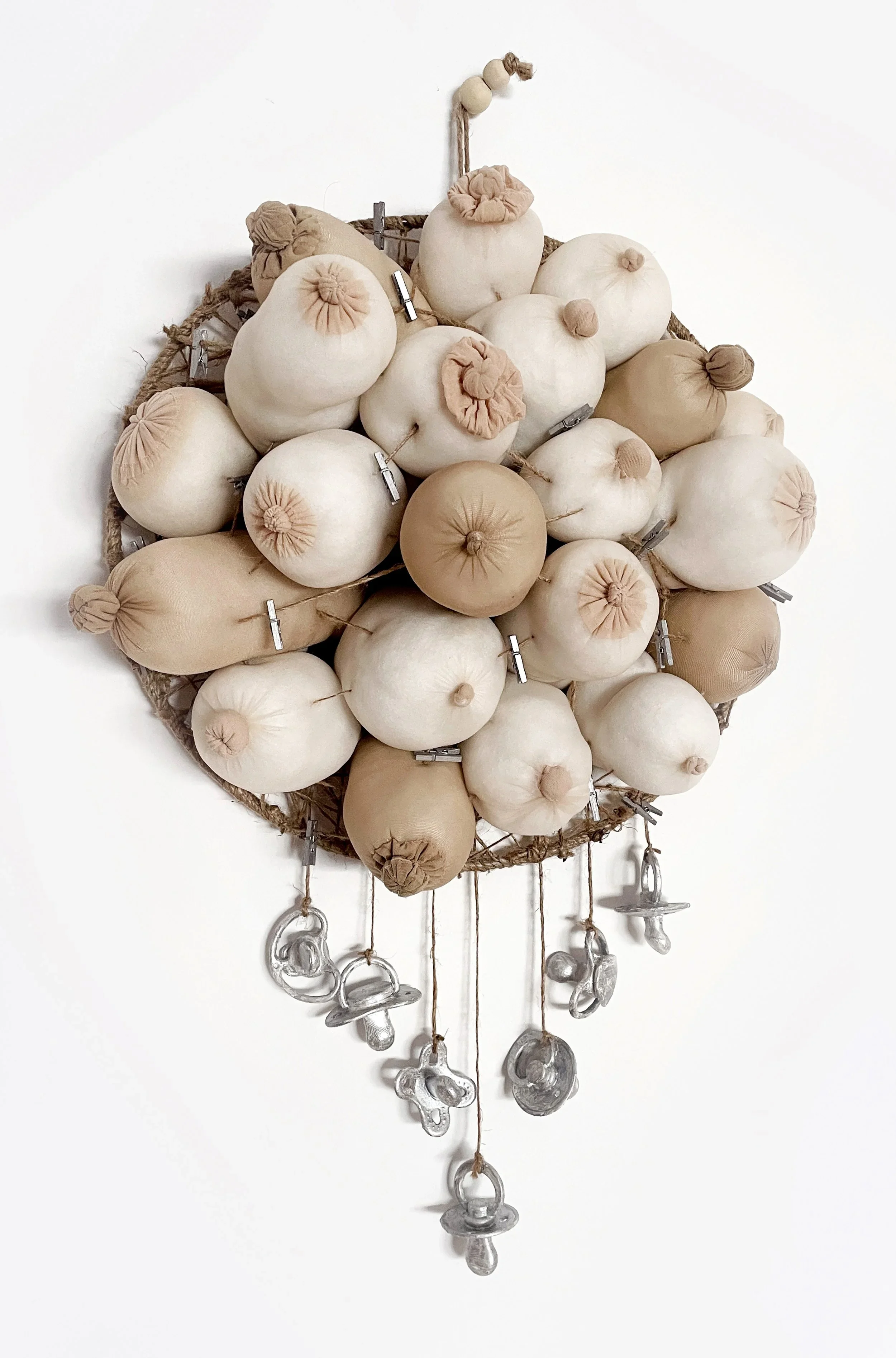
David Moješčík - MojDa is a Czech sculptor. His work is centred on figurative sculpture, the human body, and the female figure. Modelling in clay and with digital tools, he ultimately prioritises manual engagement with materials. . He draws inspiration from yoga philosophy with the concepts of non-violence and human-centeredness, as well as from Egyptian, ancient, and European classical sculpture.