

10 Questions with Divya Vinod Gilatar
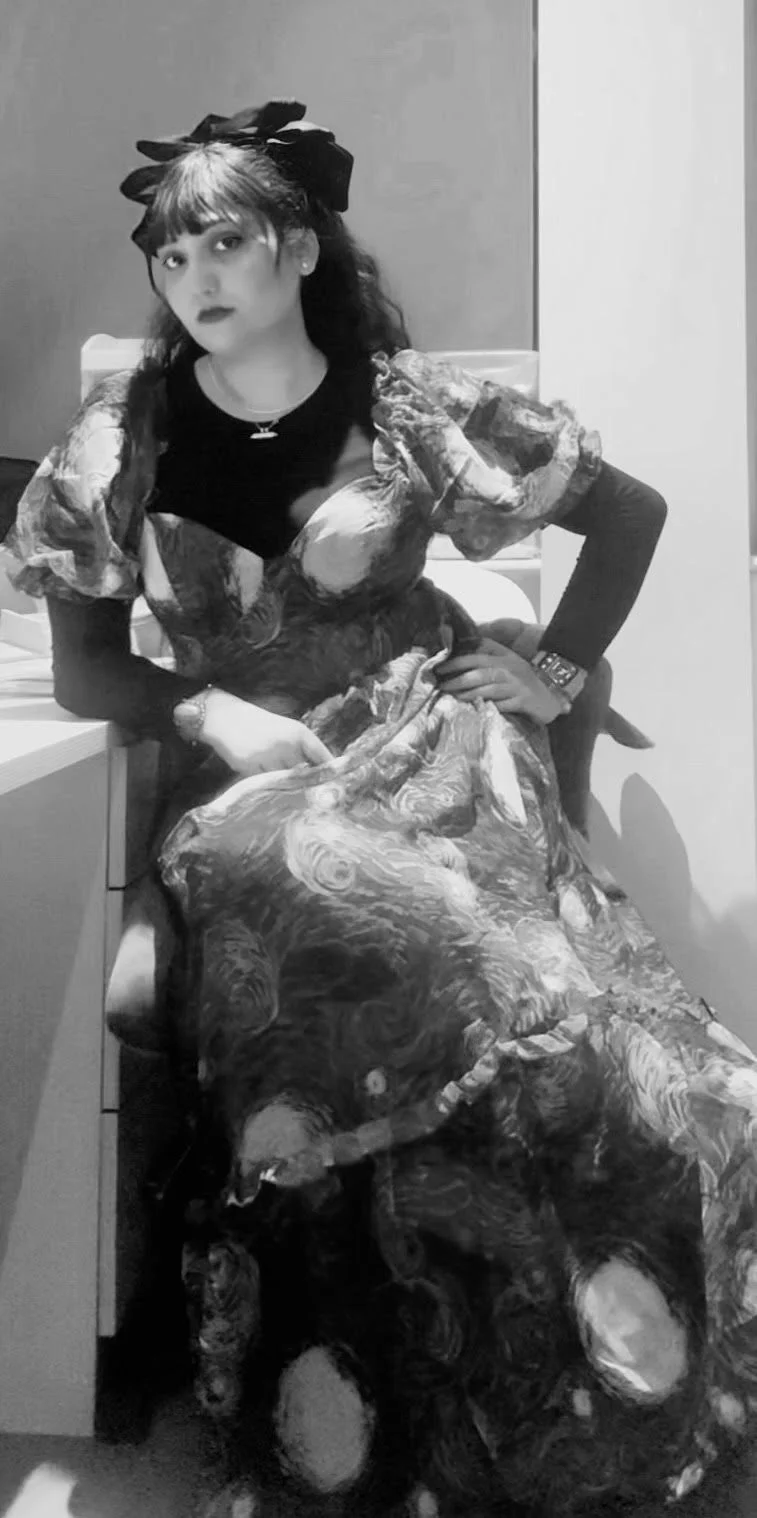
Divya Vinod Gilatar - Portrait
Divya Vinod Gilatar is a contemporary Indian artist whose practice weaves together sacred geometry, yogic philosophy, and the evolving landscape of modern spiritual identity. Born in Mumbai and currently based in the United Kingdom, she works under her creative identity The Queendom Studio, creating large-scale digital mandalas that function as meditative fields and energetic diagrams.
Her signature Chakra Mandala Series, conceived in the Himalayan foothills, explores the subtle body through refined geometric symmetry and colour vibration. Each work acts as an immersive portal, part abstract composition, part contemplative instrument, inviting viewers into inner stillness, intuition, and emotional resonance.
Divya’s artistic language is shaped by ancient Indian systems of yantra, shakti, and nature, reinterpreted through contemporary digital tools. Her work has been exhibited in London with upcoming international showcases across Paris, New York, Milan, Rome and Tokyo. Across her expanding portfolio, she continues to translate spiritual cosmologies into visually precise, conceptually grounded, and globally accessible forms, positioning her practice at the intersection of healing, abstraction, and metaphysical art.
ARTIST STATEMENT
“My work is deeply rooted in the visual and philosophical traditions of Yantra, Mandala, Shakti, and Nature. Drawing from sacred geometry, colour vibration, and yogic philosophy, I create digital mandalas that translate the metaphysical architecture of the subtle body into contemporary abstraction. Each piece is conceived as both an aesthetic composition and an energetic map, a diagram of consciousness that can be looked at, meditated with, or experienced as a portal into inner stillness.
The Chakra Mandala Series reimagines the seven primary energy centres (from Muladhara to Sahasrara) through disciplined geometry, symmetry, and controlled colour fields. These compositions arise from the ancient Indian understanding of the body as a network of vibrating energy, yet are rendered with modern digital tools, bridging traditional spiritual knowledge with contemporary visual art practices. My intention is to create work that is visually harmonious, spiritually resonant, and culturally accessible, inviting viewers into both contemplation and expansion.
At the foundation of my practice lies the yantra, a pure geometric form composed of point, line, circle, triangle, square, and lotus. In Tantric philosophy, yantras are not merely symbols but living diagrams of cosmic order. They are devices for meditation, embodiments of OM/AUM, and visual pathways toward awakening. Central to this system is the dynamic polarity of Shiva and Shakti, masculine and feminine forces whose union sustains the universe. My art glorifies Shakti, the primordial feminine energy, the transmitter of life, creativity, intuition, nourishment, destruction, and renewal.
Shakti is the power that moves through all existence: the force that makes the winds blow, the oceans churn, the sun radiate, and the human heart feel compassion and intelligence. Without Shakti, creation becomes inert. Through my digital work, I explore this elemental feminine power as both cosmic and deeply personal, an energy that manifests in the body, in nature, and in the vibrational field of colour and form.
My mandalas are therefore not only abstract geometric works but spiritual instruments. Constructed through slow, intentional, meditative process, they reveal themselves as spaces of balance, healing, and transcendence, visual frequencies that hold stillness, awaken intuition, and evoke the transformative force of the Divine Feminine.”
— Divya Vinod Gilatar
Ajna Chakra The-Third Eye Portal, Digital, 21.59 cm × 27.94 cm, 2022 © Divya Vinod Gilatar
INTERVIEW
First of all, can you tell us about your background and how you first became interested in sacred geometry and mandalas?
My interest in sacred geometry and mandalas developed through both academic study and personal exploration. My parents named me Divya, which in Sanskrit means “divine.” Growing up with that name, I became aware of a contrast between the idea of the divine and what in Indian philosophy is often described as Maya, or illusion. That distinction stayed with me and became an early point of curiosity about what is real, what is perceived, and how the visible world relates to something deeper and unseen.
After completing my undergraduate degree in Philosophy and my Master’s in Ancient Indian Culture, History, and Archaeology in 2016, I became increasingly drawn to the philosophical foundations of ancient visual systems. I began studying pre-Vedic and Vedic traditions more closely, particularly the use of yantras in Hindu practice, alongside Buddhist mandalas, Chinese spiritual systems, and the geometric structures found in medieval European cathedrals and Mughal architecture.
Across these diverse cultures, what struck me was a shared understanding that geometry is not merely decorative, but sacred, a fundamental principle through which both the visible and invisible worlds are structured. This resonated deeply with a philosophical idea often attributed to Plato, that “God geometrizes continually,” suggesting that geometry operates as a universal language of order, balance, and creation.
As my engagement with Shaktism, Tantric philosophy, and Yoga deepened, this understanding became more embodied. In particular, the Shri Yantra revealed itself to me not simply as a symbolic diagram, but as a highly sophisticated geometric expression of the divine feminine energy. It brought together everything I had been exploring, the idea that creation itself can be understood through structure, pattern, and form.
Rather than seeing geometry as something constructed, I began to understand it as something that emerges from a deeper intelligence. In that sense, creation, whether cosmic or artistic, can be understood as a movement from energy into form, from the invisible into the visible, often through geometric order. This shifted my perspective entirely, reinforcing my understanding of sacred geometry as a living, experiential system rather than a purely visual one.
This understanding became even more grounded through my training and practice as a Yoga instructor, where the relationship between body, energy, and structure became central. From that point, it felt like a natural evolution for my visual practice to take shape around sacred geometry.
Mandalas, in particular, allowed me to work with repetition, symmetry, and balance in a way that reflects both philosophical inquiry and lived experience. Over time, they became the core structure through which I explore ideas of energy, consciousness, and the body.

Anahata Chakra-The Heart Portal, Digital, 21.59 cm × 27.94 cm, 2022 © Divya Vinod Gilatar

Manipura Chakra-The Stomach Portal, Digital, 21.59 cm × 27.94 cm, 2022 © Divya Vinod Gilatar
You combine ancient philosophies with digital tools. How do you balance tradition and technology in your work?
I approach these systems with both respect and continuity. Ancient cultures and philosophies are not static historical artefacts; they are living frameworks of understanding. My use of digital tools is not a departure from tradition, but an extension of it. By translating these principles into contemporary visual language, I aim to demonstrate that they remain relevant and accessible in the present moment. The intention is not to replicate tradition, but to activate it within a contemporary context.
Your works are described as both visual and meditative. How do you hope viewers engage with them?
These works were originally created while I was living in the Himalayas, during a period when I was working as a yoga instructor and chakra healer. They were developed as digital mandalas for meditation and to support work with energetic blockages in the body. In exhibition spaces, I have observed a similar response. Viewers tend to slow down in front of the work, often spending longer than expected engaging with it. There is a noticeable shift from simply looking to a more immersive experience, where the repetition and symmetry create a meditative pull. This aligns closely with my intention to create moments of stillness within a fast-paced visual environment.
What drew you to focus specifically on the chakra system in your Chakra Mandala Series?
My focus on the chakra system developed gradually, through both academic study and lived practice. I was first introduced to it more formally in 2018 during my training as a yoga educator at The Yoga Institute in Mumbai, although my earlier studies in yoga philosophy, Indian thought, and ancient cultural history had already laid the groundwork. What drew me in was not just the theoretical framework but the idea that the body could be understood as an energetic system, where physical, emotional, and psychological states are interconnected.
This understanding deepened when I began studying chakra healing and applying it in my own life. The changes I experienced were not only physical, but also emotional and mental. That personal shift made the system feel real, not abstract.
The turning point came while I was living in Shimla, in the foothills of the Himalayas, where I was working closely with clients and designing meditation practices. I began incorporating colour therapy, drawing from the idea that each chakra is associated with a specific vibrational frequency expressed through colour. From there, it felt natural to bring my visual practice into that space.
The mandalas emerged as a way of translating these energetic concepts into a visual form. For instance, in my work, based on the Vishuddhi (throat) chakra and the colour associated with it being blue, I used the colour blue as a dominant field, not just symbolically, but as a way of holding a specific energetic quality. When used in meditation, many individuals reported not only a sense of physical ease but also a shift in their ability to express themselves more openly.
That experience was important to me because it positioned the work not just as an image, but as something that could be engaged with experientially.
The Chakra Mandala Series grew out of this intersection, where philosophy, practice, and visual language come together. It is not simply about representing the chakra system, but about exploring how these ideas can be translated into a contemporary form that sits between art, embodiment, and perception.

Muladhara Chakra-The Root Portal, Digital, 21.59 cm × 27.94 cm, 2022 © Divya Vinod Gilatar
The concept of Shakti is central to your practice. What does this energy mean to you personally?
The concept of Shakti is not just an influence on my work; it is the foundation of how I understand existence. I am devoted to Shaktism within the Tantric tradition, and my personal practice of Shakti worship has been central to my life for many years. For me, Shakti is not a metaphor or symbolic idea; it is the primordial force that creates, sustains, and transforms the universe. Everything that exists does so through Shakti. Without it, there is no movement, no creation, nothing. Even within the traditional understanding of Shiva and Shakti, it is said that without Shakti, Shiva is inert. This idea deeply informs how I perceive both the cosmos and the body.
What feels equally important to me is Shakti as Mother, not simply as a nurturing presence, but as the total force of creation itself. The same energy that gives birth to life also dissolves it. It is cyclical, like nature, present in the rhythms of the earth, the changing seasons, and the cycles of the body. The female body is not separate from nature; it mirrors it. Menstruation, creation, and nourishment are not intimate or hidden processes, but expressions of a universal intelligence.
While Shakti is often described as feminine, I see it as a universal life force present within every human being. The difference is that most people remain disconnected from it. My practice, both spiritual and artistic, is about recognising, activating, and embodying that energy.
Historically, the worship of the Divine Feminine was deeply rooted in ancient Indian traditions before patriarchal systems began to suppress it. Reconnecting with Shakti, for me, is also a way of reclaiming that space, personally, culturally, and spiritually.
My connection to Shakti is not theoretical. It comes through lived practice and devotion, particularly to forms such as Goddess Kamakhya, Goddess Kali, and the Divine counterpart of Lord Krishna - Shree Radha. These are not distant deities to me, but active, experiential energies that shape how I see and create.
In my work, I am not trying to illustrate spirituality. I am attempting to translate Shakti itself into a visual language. The Chakra Mandala series emerges directly from this process, where geometry, colour, and repetition become a way of mapping energy rather than simply representing form.
For me, Shakti is not an idea I explore; it is something I live. My work is an extension of that, an attempt to make visible the force that moves through both the body and the universe.
Your process is described as slow and meditative. What does a typical working session look like for you?
My process is a synthesis of intuition, meditation, and structure. I approach my work as a deeply personal and almost devotional practice. I prefer to work in silence, or occasionally with minimal music, as I need to remain fully present and connected to the process. Before beginning, I spend time in stillness, allowing the form to emerge intuitively rather than forcing it. From that meditative state, the geometric and structural aspects of the work begin to develop. I do not impose geometry onto the piece; instead, it reveals itself through the process. There is a continuous dialogue between intuition and precision, where the work evolves organically but within a disciplined framework. In that sense, the act of creation becomes both contemplative and exact, a balance between surrender and control, where the work is discovered as much as it is constructed.
Colour plays an important role in your mandalas. How do you decide on your palettes?
Colour is central to the emotional and energetic resonance of each piece. While each chakra is traditionally associated with a specific colour, working within a predominantly monochromatic palette requires a more nuanced approach. I focus on variations in tone, saturation, and luminosity to create depth and movement within a single colour field. The aim is not just to represent the colour of a mandala or chakra, but to evoke its vibrational quality, whether that is grounding, expansion, expression, or stillness.

Sahasrara Chakra-The Crown Portal, Digital, 21.59 cm × 27.94 cm, 2022 © Divya Vinod Gilatar

Swadhisthana Chakra-The Womb Portal, Digital, 21.59 cm × 27.94 cm, 2022 © Divya Vinod Gilatar
Do you see your work more as art, a spiritual tool, or a combination of both?
I see my work as a combination of both, but not in a way where art and spirituality exist as separate categories. For me, they are inseparable. My practice began as a spiritual one, rooted in Shaktism and informed by Tantric philosophy as well as my experience with Yoga as a lived, embodied discipline. The earliest works in this series emerged as healing mandalas, created through my engagement with Yoga and Shakti Sadhana. They were not initially intended to function as art objects, but as tools for meditation, alignment, and connection with the divine feminine energy. What became clear over time is that when this internal, experiential process is translated into a visual language, it begins to operate on multiple levels. The work retains its function as a spiritual tool, but it also enters the space of contemporary art, where it can be seen, interpreted, and engaged with by others.
I am not interested in separating these roles. In many ways, that division is a modern construct. Within Tantric and Shakta traditions, as well as in yogic practice, the body, breath, awareness, and image are all part of a continuous field of experience. My work emerges from that space, where the act of creation itself becomes a form of practice.
At the same time, I am aware that my work exists within a contemporary context. It is not devotional art in a traditional sense, nor is it purely aesthetic. It operates in a threshold space, where sacred geometry, embodied experience, and the concept of divine feminine energy intersect.
For me, the work functions both as an energetic and conceptual system. It can be approached as a meditative object, something that holds and transmits presence, but it can also be read critically, as an exploration of embodiment, symbolism, and the representation of feminine power.
Rather than choosing between art and spiritual tool, I see my work as a site where both coexist, where Tantra, Shaktism, and Yoga are not illustrated, but translated into form. It is, ultimately, an attempt to make visible something that is usually experienced but rarely seen.
How has living between India and the United Kingdom influenced your artistic perspective?
Living between India and the United Kingdom has shaped my artistic perspective in a very layered way. I was born and raised in Mumbai, a highly metropolitan and deeply multicultural city. Growing up in South Bombay, I was surrounded by a mix of colonial architecture, contemporary urban life, and a strong cultural presence shaped by both tradition and modernity. Mumbai, as the home of Bollywood, also exposed me early on to a visual culture that is vibrant and influential, but at the same time often reduces the female body to something performative and sexualised. While I appreciate its aesthetic and cultural impact, that aspect never fully resonated with me.
In many ways, that discomfort became a starting point. It led me to question how femininity is represented and to explore the idea of feminine energy beyond surface-level depiction. This is where my engagement with Shaktism deepened, and where my work began to shift towards understanding the body as something sacred, rather than something to be consumed or viewed.
Living in the United Kingdom created a different kind of distance. It allowed me to step outside my own cultural context and see it from another perspective. At the same time, it exposed me to how my work is read by audiences who do not share the same cultural or spiritual background. That contrast has been important; it has made me more conscious of how meaning travels, how symbols translate, and how to communicate something deeply rooted in Vedic or Indian philosophy through a contemporary, global visual language.
So my practice now exists between these two spaces. India gives me the philosophical and spiritual foundation, while the UK allows me to critically reflect, reinterpret, and present that work in a way that can be engaged with across different cultural contexts with sensitivity.

Vishuddhi Chakra The Throat Portal, Digital, 21.59 cm × 27.94 cm, 2022 © Divya Vinod Gilatar
And lastly, what are you currently working on, and how do you see your practice evolving in the future?
At the moment, my practice is evolving across multiple but interconnected directions. I am currently developing a larger body of work centred on the concept of Shakti or the Divine Feminine Energy, which is unfolding in two parts. The first, Shakti in Motion, explores the female body as a site of cyclical energy, focusing on themes such as menstruation, womb consciousness, nourishment, and motherhood. The second, Shakti in Form, extends this inquiry into a broader visual language, examining different manifestations of the divine feminine through contemporary, geometry-based compositions.
Alongside this, I am also working on a fully illustrated children’s book. As a children’s book illustrator, writer, and early childhood educator, this project allows me to translate some of these ideas into a more accessible and narrative-driven format. While it operates differently from my mandala-based work, it is still rooted in the same underlying values of care, imagination, and emotional awareness.
Looking ahead, I see my practice expanding as a cohesive system rather than separate projects. I am interested in continuing to explore the intersection of art, embodiment, and spiritual philosophy, while also building a body of work that can exist across different contexts, exhibitions, publications, and educational spaces.
Ultimately, I see my work evolving into a sustained exploration of the body as both a personal and universal site of experience, where themes of the divine feminine, energy, and transformation continue to unfold in new forms.
Artist’s Talk
Al-Tiba9 Interviews is a promotional platform for artists to articulate their vision and engage them with our diverse readership through a published art dialogue. The artists are interviewed by Mohamed Benhadj, the founder & curator of Al-Tiba9, to highlight their artistic careers and introduce them to the international contemporary art scene across our vast network of museums, galleries, art professionals, art dealers, collectors, and art lovers across the globe.




Run Wu is a Chinese Australian interdisciplinary digital artist, filmmaker, and signed commercial director currently based in Paris and London. Drawing inspiration from his multicultural background and experiences across continents, Run's work often reflects themes of displacement, transformation, and the human condition.